

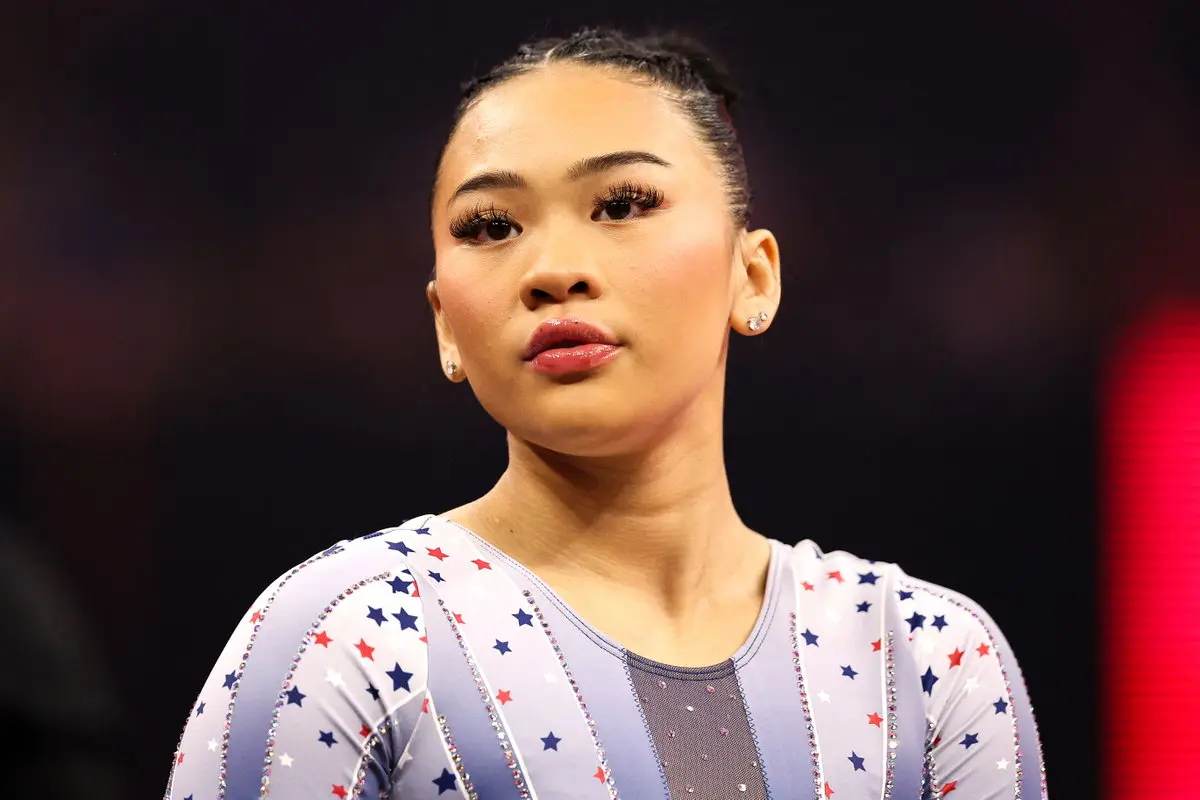
In a recent interview with FOX 9 Minneapolis-St. Paul, Suni Lee, the Olympic gymnastics champion, made a startling revelation about her experience competing under the intense pressure of the Olympics. She admitted, “I definitely have blacked out a couple of times and not remembered what’s happened because it’s just so stressful in the moment.” This candid confession sheds light on the often-hidden mental and physical toll that elite gymnastics exacts on its athletes.
Lee’s admission comes five years after her stunning performance at the Tokyo Olympics in 2021. At just 18 years old, she arrived in Tokyo with a lingering foot and ankle injury, and few expected her to become the face of Team USA in her first Olympic Games. But when Simone Biles withdrew from the team final, Lee was thrust into the spotlight. With the U.S. trailing the Russian Olympic Committee, she stepped up on the uneven bars, scoring a remarkable 15.400, helping the U.S. secure a silver medal. To fans, it appeared to be a moment of sheer courage and composure. Now, Lee reveals that behind that composed exterior, her mind was often going blank from the pressure.
A Life Dedicated to Gymnastics
Sunisa Lee was born on July 9, 2003, in St. Paul, Minnesota, to parents Yeev Thoj and John Lee. She began gymnastics at a young age, training at Midwest Gymnastics Center in Little Canada, Minnesota. Her talent was evident early, and she quickly rose through the ranks. By 2019, she was a senior elite gymnast and made her mark at the U.S. National Championships, winning silver in the all-around. Her breakout came at the 2019 World Championships, where she helped the U.S. win a team gold and earned a bronze on the uneven bars.
Heading into the Tokyo Olympics, Lee was seen as a strong contender but not necessarily the leader. However, after Biles’ withdrawal, Lee became the team’s anchor. She went on to win the all-around gold, becoming the first Hmong-American Olympic gold medalist. She also added a bronze on the uneven bars and a silver in the team event. Her achievements made her a household name and a role model for young gymnasts worldwide.
The Harsh Reality of Olympic Pressure
Lee’s recent interview was conducted during her visit to Minnesota for the Special Olympics USA Games, where she spent time meeting athletes and attending events. When asked about what she tells young gymnasts who look up to her, she emphasized the importance of breathing and trusting in one’s confidence. But she also shared the darker side of competing at the highest level. “It’s not easy to go out there and compete in front of so many people with such high stress,” she said. “I remember when I was competing, I definitely have blacked out a couple of times and not remembered what’s happened because it’s just so stressful in the moment. So hard to feel anything else.”
This phenomenon, where athletes experience a temporary loss of memory or awareness under extreme stress, is not uncommon in high-stakes sports. Psychologists refer to it as dissociative amnesia or a stress-induced blackout. For gymnasts, the combination of physical exertion, mental focus, and immense pressure can trigger this response. Lee’s willingness to speak openly about it highlights the importance of mental health in sports, a topic that has gained significant traction since Biles’ withdrawal from the Tokyo Games due to mental health concerns.
Health Struggles and Comeback
Lee’s journey after Tokyo was not without its challenges. In 2023, she was diagnosed with two rare kidney diseases that caused severe swelling in her body, including her face, hands, and legs. The condition forced her to step away from gymnastics as her body was not responding normally to training. She had to undergo treatment and slowly regain her strength. Despite the setbacks, Lee worked her way back into competition, eventually qualifying for the Paris 2024 Olympics.
At the Paris Games, Lee once again proved her resilience. She helped Team USA win the gold medal in the team event and earned bronze medals in the individual all-around and on the uneven bars. Her performance was a testament to her determination and love for the sport. However, she also noted that the support systems at the Olympics, including constant health checks and mental health care, were crucial for her. “I feel like it’s something I needed when I was competing,” she said, reflecting on the care provided during the Special Olympics.
College Career and Life Beyond Gymnastics
In 2021, Lee enrolled at Auburn University, becoming the first reigning Olympic all-around champion to compete in NCAA gymnastics. Her college career was filled with accolades: she won an NCAA title on the balance beam in 2022 and an SEC title on the uneven bars the same year, along with several perfect 10.0 scores. Her presence at Auburn drew massive crowds and brought national attention to college gymnastics.
After the Paris Olympics, Lee has begun to explore life outside the gym. She has ventured into fashion, collaborating with brands like Lululemon and American Eagle, and was featured in the 2025 Sports Illustrated Swimsuit Issue at age 22. These new roles have allowed her to build a personal brand and secure her financial future. Yet, she has not closed the door on gymnastics. “I think last Olympics I put so much pressure on myself,” Lee said. “I just kind of want to see where I’m at and how my body feels.” She continues light training at Midwest Gymnastics Center, keeping the possibility of a return for the 2028 Los Angeles Olympics alive.
The Unpredictable Path Ahead
Lee’s future in elite gymnastics remains uncertain. She has achieved everything a gymnast could dream of: Olympic gold, NCAA titles, and global recognition. The physical toll of her kidney disease and the mental strain of competition are significant factors. However, her continued training suggests she is not ready to retire. At 23, she is still young by gymnastics standards, though the sport typically sees athletes peak in their late teens and early 20s. A potential run at LA 2028 would make her one of the oldest female gymnasts to compete for the U.S. Olympic team.
Regardless of what she decides, Lee’s legacy is secure. She has inspired countless young athletes, particularly within the Hmong community, and has been a vocal advocate for mental health and self-care. Her admission about blacking out under pressure only adds to her authenticity, showing that even the greatest athletes face moments of vulnerability. As she continues to balance her life between gymnastics and other pursuits, one thing is certain: Suni Lee’s story is far from over.
The conversation around athlete mental health continues to evolve, and Lee’s experiences serve as a reminder of the hidden struggles behind seemingly flawless performances. Her journey from a young gymnast in Minnesota to an Olympic champion and soon-to-be role model for holistic athlete well-being is a testament to her strength both in and out of the arena.
Source:Yahoo Sports News