

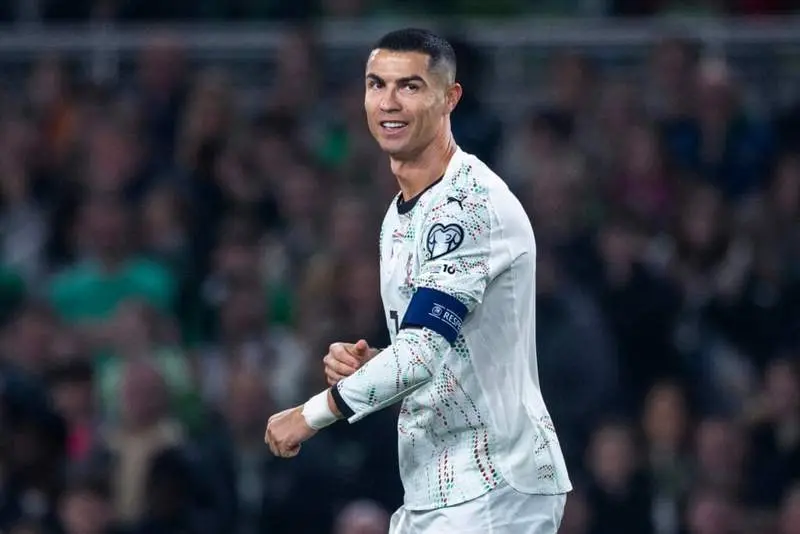
Portugal national team manager Roberto Martinez has firmly dismissed the notion that Cristiano Ronaldo is still playing football for financial gain or to add to his trophy collection. Speaking to Portuguese broadcaster Antena 1, Martinez emphasized that Ronaldo's motivation runs much deeper, rooted in a relentless pursuit of self-improvement that has defined his extraordinary career.
“Cristiano does not play for money, he does not play for titles, he plays to improve. And that is incredible,” Martinez said. The Catalan coach elaborated by pointing out that even after winning the Champions League or the European Golden Shoe, Ronaldo is back the next day trying to get better. This perspective offers a sharp rebuttal to critics who have long questioned Ronaldo's motives, especially as he continues playing at an age when most elite footballers have retired.
The mindset behind the longevity
Cristiano Ronaldo's career spans over two decades at the highest level. He has won five Ballon d'Or awards, five UEFA Champions League titles, multiple domestic league championships in England, Spain, Italy, and Saudi Arabia, and the UEFA European Championship with Portugal in 2016. Individually, he holds records for most international goals, most Champions League goals, and most appearances in the competition, among many others. By any measure, he has already achieved everything a footballer could dream of.
Yet Martinez insists that what keeps Ronaldo going is not a desire to pad his resume but an internal fire that refuses to be extinguished. “It is unique to have a journey of 22 years for the National Team, the number of games he is playing, there is no other player. It is the hunger,” Martinez said. “We can measure everything from a player, but it is an aspect that is not possible.” This hunger, as Martinez calls it, is something intangible that cannot be captured by statistics. It explains why Ronaldo continues to train obsessively, maintain a rigorous physical regimen, and demand the best from himself and those around him.
Ronaldo's role in Portugal's World Cup ambitions
As Portugal gear up for the 2026 FIFA World Cup, Ronaldo's place in the squad has been a topic of debate. At 41, he is no longer the explosive winger who terrorized defenses in his prime. His role has evolved into that of a poacher and leader off the pitch. However, Martinez has consistently backed Ronaldo, citing his professionalism and influence in the dressing room. The manager's latest comments reinforce that trust.
Martinez's Portugal have a blend of young talent like Vitinha, João Neves, and Gonçalo Ramos alongside seasoned veterans like Ronaldo and Pepe. The challenge is to integrate Ronaldo's experience without relying on him as the sole goal-scoring threat. Yet Martinez believes Ronaldo's presence elevates the entire squad. “His hunger is contagious. Young players see how he prepares, how he recovers, how he pushes himself. That cannot be taught,” Martinez added.
Portugal will be aiming to improve on their quarterfinal exit in 2022. With a deep squad and a motivated captain, they are considered one of the dark horses for the tournament. Ronaldo's potential participation would be his sixth World Cup, a record shared with few others. His motivation, as described by Martinez, is not about breaking records but about proving he can still compete at the highest level.
Historical context and comparisons
The question of motivation has followed Ronaldo throughout his career. From his early days at Sporting CP to his record-breaking stint at Real Madrid, his move to Juventus, his return to Manchester United, and his current spell at Al Nassr, critics have often accused him of prioritizing personal glory over team success. Martinez's remarks challenge that narrative by framing Ronaldo's drive as pure competitiveness.
Comparisons with Lionel Messi, his eternal rival, are inevitable. Messi's journey has been different, with a more laid-back demeanor, yet both share an insatiable will to win. Martinez's distinction is that for Ronaldo, the motivation goes beyond trophies—it is about the daily act of improving. This is reminiscent of other sporting greats like Michael Jordan or Tom Brady, who famously obsessed over incremental gains even after achieving everything.
Some pundits have argued that Ronaldo's decision to move to Saudi Arabia was financially motivated. Martinez's comments indirectly address that criticism by suggesting that while money may be a factor in any player's career, for Ronaldo it is not the primary driver. “He could have retired years ago, a legend. But he continues because he loves the challenge, the routine, the competition,” Martinez said.
The 22-year international journey
Ronaldo made his debut for Portugal in 2003, at the age of 18. Since then, he has amassed over 200 caps, scored more than 130 international goals, and captained his country to their first major tournament victory at Euro 2016. He also led Portugal to glory in the inaugural UEFA Nations League in 2019. His longevity is unprecedented in international football.
Martinez highlighted that no other player has had such a long and consistent career for a national team. “22 years for the National Team—there is no other player with that kind of journey.” The sheer number of games and the physical toll make Ronaldo's commitment even more remarkable. Martinez sees this as a testament to Ronaldo's mental strength and his ability to reinvent himself.
As Portugal prepare for the World Cup, Ronaldo's experience will be invaluable. The younger generation looks up to him, and his presence in the squad can inspire. However, Martinez is careful not to over-rely on him. The team has other goal-scoring options, and the system does not revolve around Ronaldo as it did in previous tournaments. This balance is key to Portugal's success.
The intangible factor
What Martinez is really trying to convey is that Ronaldo's drive is something that defies measurement. Goals, assists, minutes played, and even trophies are all quantifiable. But the desire to improve each day, to push beyond limits, is a quality that cannot be captured in a spreadsheet. This is what Martinez calls the “hunger” that makes Ronaldo unique.
Ronaldo's training methods are legendary. He reportedly sleeps in hyperbaric chambers, follows a strict diet, and spends hours on recovery techniques. This dedication is not just about prolonging his career; it is about reaching new levels of performance even when no one expects it. Martinez's comments reinforce that for Ronaldo, football is not a job or a means to an end—it is a platform for personal excellence.
In an era where players often prioritize brand and business, Ronaldo's focus remains on the pitch. He is still the first to arrive at training and the last to leave. His competitive nature manifests in every drill, every match, and every interaction. This is the example Martinez wants to highlight, not just for the media but for his players. “We can measure everything from a player, but it is an aspect that is not possible,” Martinez concluded, referring to Ronaldo's inner flame.
As the 2026 World Cup approaches, all eyes will be on how Ronaldo performs. Martinez's vote of confidence suggests that the captain will play a significant role, not just as a symbol but as a contributor. If Ronaldo's hunger is indeed his greatest asset, Portugal will have a weapon that no other team can boast: a 41-year-old who plays as if he has everything to prove.
Source:Yahoo Sports News