

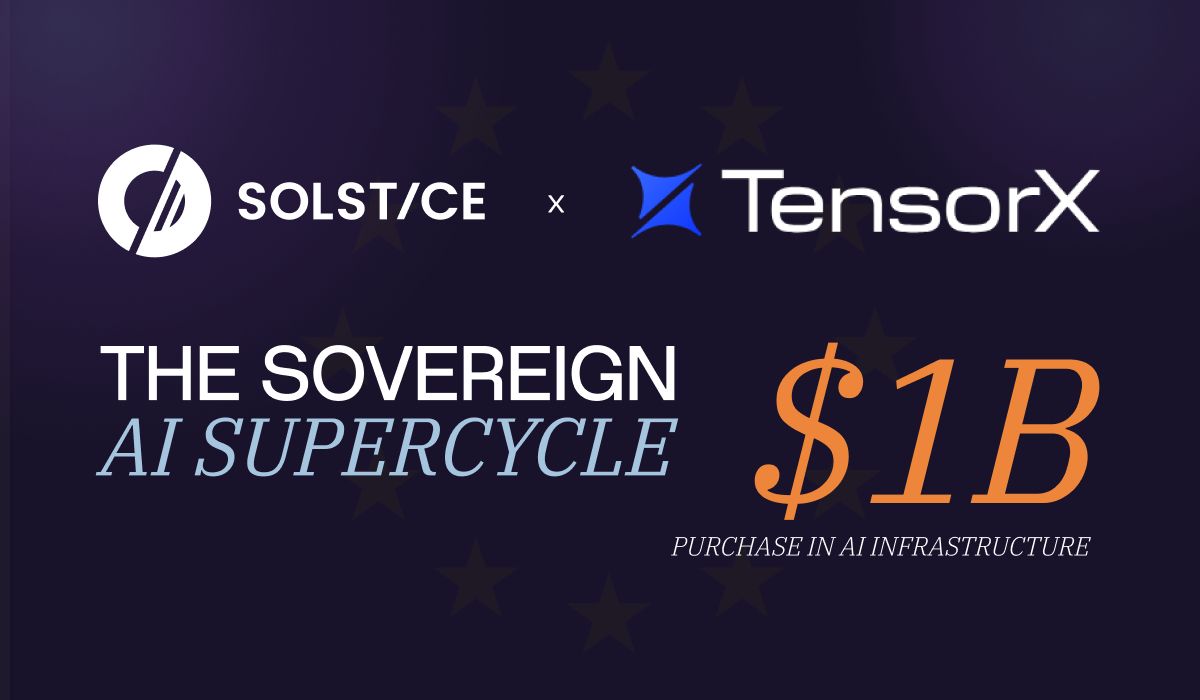
Solstice, a leading investment firm specializing in technology and energy infrastructure, has partnered with Tensorx, a pioneering company in high-performance computing and cloud infrastructure, to deploy $1 billion in AI infrastructure across the European Union. This strategic investment is designed to meet the surging demand for sovereign AI capabilities, enabling European organizations to train and run large-scale AI models without relying on non-EU cloud providers or data centers.
The announcement comes at a critical juncture as the EU intensifies its efforts to achieve digital sovereignty. With the rapid advancement of generative AI and large language models, European policymakers, businesses, and researchers have become increasingly concerned about dependence on foreign infrastructure, particularly from the United States and China. The Solstice-Tensorx partnership directly addresses these concerns by creating a dedicated, high-performance computing network that prioritises data residency, security, and compliance with the EU's stringent data protection laws, including the General Data Protection Regulation (GDPR).
What the $1 Billion Investment Covers
The $1 billion commitment will be allocated over the next three years to build a series of state-of-the-art AI data centres across multiple EU member states. These facilities will be equipped with Tensorx's proprietary tensor processing units (TPUs) and next-generation graphics processing units (GPUs) from leading semiconductor manufacturers. The infrastructure is designed to support both training of large-scale foundation models and efficient inference for real-time applications.
Key components of the investment include:
- Construction of five new AI-optimized data centres in Germany, France, the Netherlands, Sweden, and Spain, each offering low-latency connectivity to major research hubs.
- Deployment of over 50,000 advanced accelerators capable of delivering exaflop-scale performance for AI workloads.
- Development of a federated learning layer that allows European universities and startups to collaborate on model training while keeping proprietary data within national borders.
- Implementation of energy-efficient cooling systems and integration with renewable energy sources to minimise environmental impact.
Tensorx, known for its expertise in custom chip design and liquid-cooled server architectures, will provide the core compute infrastructure, while Solstice will manage the financing, site selection, and regulatory approvals. The partnership has already secured preliminary agreements with several EU national governments to access subsidised renewable energy and expedited permitting for data centre construction.
The Strategic Importance of EU Sovereign AI
The concept of sovereign AI has gained significant traction in Brussels over the past two years. The European Commission's 2024 AI Innovation Package stressed the need for 'AI made in Europe' to ensure that the continent's values of transparency, accountability, and inclusivity are embedded in foundational models. However, a major bottleneck has been the lack of affordable, large-scale compute capacity within Europe. Most European AI startups currently rely on cloud services from Amazon Web Services, Microsoft Azure, or Google Cloud, all of which store and process data primarily on servers located outside the EU, raising concerns about data sovereignty and potential extra-territorial access by foreign governments.
By investing $1 billion in dedicated infrastructure, Solstice and Tensorx are directly tackling this bottleneck. The new data centres will offer European companies a 'sovereign compute' option: all data remains under EU jurisdiction, and access by non-EU entities is prohibited by contract and technical design. This is particularly attractive for sectors such as healthcare, defence, finance, and public administration, where sensitive data must stay within national borders.
Moreover, the investment aligns with the EU's broader push for technological resilience. The ongoing semiconductor supply chain disruptions and geopolitical tensions have underscored the risks of over-reliance on a small number of non-European technology providers. By fostering an indigenous AI infrastructure ecosystem, the EU hopes to attract more talent and innovation, reduce import dependency, and create a level playing field for European AI champions.
Industry analysts estimate that Europe currently accounts for less than 10% of global AI compute capacity, despite being home to around 25% of the world's top AI researchers and a vibrant startup scene. The Solstice-Tensorx announcement is seen as a tangible step toward closing this gap. "This is not just about building server farms; it's about building the factories of the future for AI," said Dr. Marlena Voss, a senior fellow at the European Centre for Digital Competitiveness. "Sovereign AI requires sovereign compute, and this investment provides the bedrock for Europe to compete on its own terms."
Background on the Partners: Solstice and Tensorx
Solstice was founded in 2015 with a mission to finance critical infrastructure projects that bridge the gap between cutting-edge technology and sustainable development. The firm has previously invested over €3 billion in renewable energy grids, smart city networks, and quantum computing facilities across Europe. Known for its patient capital approach and deep expertise in navigating complex regulatory landscapes, Solstice has become a trusted partner for governments seeking to accelerate digital transformation while meeting climate goals. The firm's leadership team includes former senior officials from the European Investment Bank and technology strategists from major semiconductor companies.
Tensorx, headquartered in Cambridge, UK, was established in 2018 by a team of engineers from Google's Tensor Processing Unit project. The company has developed a unique tensor computing platform that claims to deliver up to 4 times better performance per watt for AI training compared to conventional GPU clusters. Tensorx has already deployed its infrastructure in major research laboratories in the US and Asia, but this marks its largest ever single investment in Europe. The company's IP portfolio includes over 200 patents in chip architecture, interconnects, and memory hierarchy, making it a formidable player in the AI hardware space.
The partnership between Solstice and Tensorx was initiated in late 2024, when both companies recognised a convergence of interests. Solstice needed proven, high-performance technology to underpin its sovereign AI vision, while Tensorx required a financially robust partner with strong government relationships to scale in Europe. The result is a vertically integrated proposition that combines world-class hardware with turn-key finance and operations.
Implications for European AI Research and Startups
The $1 billion infrastructure will provide immediate relief to European AI researchers who have long struggled with limited access to compute. Several leading universities, including ETH Zurich, Cambridge, and the Max Planck Society, have already expressed interest in reserving a portion of the compute capacity for open-science projects. This could accelerate breakthroughs in areas like protein folding, climate modelling, and multilingual natural language processing for Europe's many languages.
For startups, the availability of sovereign compute could be a game-changer. Many European AI companies have reported difficulties in scaling due to high cloud costs and latency. With local, cost-effective compute, they can iterate faster and keep data within the GDPR umbrella. The partners have also hinted at a programme to allocate compute credits to early-stage startups based on research merit, similar to the compute initiatives by the European High-Performance Computing Joint Undertaking (EuroHPC).
However, experts caution that hardware alone is not enough. "Sovereign AI also requires skilled talent, robust datasets, and clear regulations," noted Dr. Francois Lambert, director of the AI Policy Lab at the University of Brussels. "This investment is essential but must be complemented by initiatives like the European AI Alliance and the upcoming Common European Data Spaces to truly succeed." Despite the caveats, the Solstice-Tensorx deal represents the largest single private investment in European AI compute to date, dwarfing previous projects such as the €400 million Leonardo supercomputer in Italy.
Environmental and Regulatory Considerations
Building large-scale AI data centres has significant environmental implications. The Solstice-Tensorx consortium has committed to powering all new facilities with 100% certified renewable energy from the first day of operation. Moreover, the data centres will utilise Tensorx's advanced liquid-cooling technology that reduces water consumption by 90% compared to traditional air cooling, and the waste heat will be captured and used for district heating in nearby communities. These measures align with the EU's Digital Europe Programme and the Green Deal objectives.
On the regulatory front, the project must navigate EU state aid rules and competition law. The partners have been in dialogue with DG Competition and are structuring the investment as a purely private commercial venture, without direct government subsidies. However, they are benefiting from recent EU regulations that allow preferential tariffs for large energy users that invest in efficiency and renewables. The project's diversity across multiple member states also helps distribute economic benefits and may receive support from national digital sovereignty funds, such as France's €1.5 billion AI plan and Germany's Zukunftsfonds.
One potential challenge is the geopolitical dimension. Some EU officials have expressed concern about any foreign ownership or influence in critical AI infrastructure. Both Solstice and Tensorx are European-owned companies (Tensorx is UK-based, which is outside the EU but still considered a friendly partner under the EU-UK Trade and Cooperation Agreement). The partnership has voluntarily agreed to comply with a 'European control clause' that prohibits any change of control or transfer of technology to non-European entities without prior approval from the relevant EU regulatory bodies. This extra layer of sovereign assurance is likely to smooth approval processes.
Longer-Term Vision and Competitor Landscape
The $1 billion investment is just the first phase. Both companies have indicated they are prepared to double the funding if demand materialises, potentially reaching €2 billion by 2030. They also plan to create a dedicated 'Sovereign AI Compute Consortium' that includes other European infrastructure investors and cloud providers to standardise interfaces and promote interoperability. This consortium could eventually rival the capacity of hyperscalers like AWS, but with a distinctly European governance model.
Competitors are taking notice. France's OVHcloud and Germany's Hetzner have already announced expansions of their GPU-as-a-service offerings, and the European Commission is considering a pan-European 'AI Factory' public investment scheme of up to €10 billion. The Solstice-Tensorx move may catalyse further private investment, accelerating the timeline for European AI sovereignty. For now, the partnership is positioned as a market leader, offering perhaps the most advanced performance-per-watt metrics available in Europe.
As the first construction phases begin in the second quarter of 2026, the global AI community will be watching closely. If successful, the Solstice-Tensorx model could become a blueprint for other regions seeking digital sovereignty without relinquishing technical leadership. The undertaking is bold, ambitious, and fraught with technical and financial risks, but the potential rewards—for European innovation, economic resilience, and democratic control over transformational technology—are immense.
The announcement sent ripples through the tech sector, lifting shares of European semiconductor companies and spurring debate about how quickly the continent can catch up in the global AI arms race. With this $1 billion bet, Solstice and Tensorx are betting that sovereignty and innovation can go hand in hand, and that Europe's AI future need not be written by others.
Source:The Daily Hodl News