

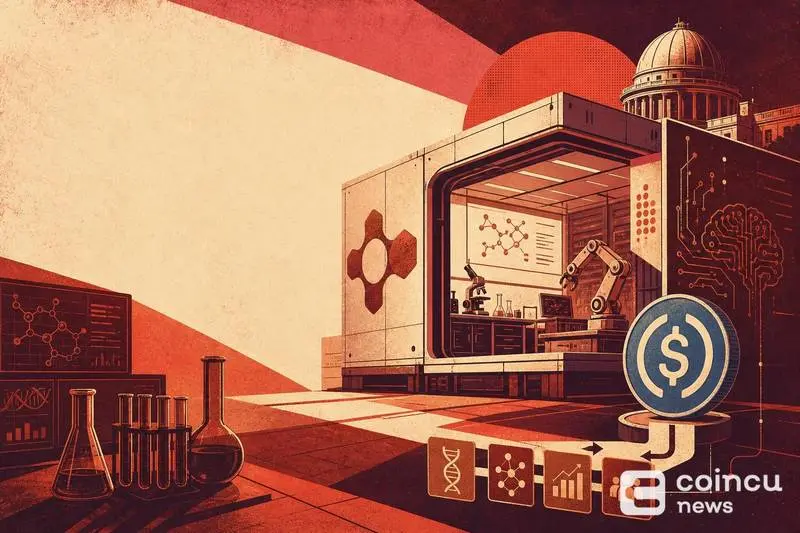
Bio Protocol has officially launched OpenLabs, a decentralized platform designed to bridge scientific researchers, builders, and artificial intelligence agents through a USDC-based revenue model. This initiative marks a significant step in the decentralized science (DeSci) movement, offering an alternative to traditional grant systems that often involve lengthy application cycles and institutional gatekeepers. By leveraging blockchain infrastructure, OpenLabs aims to provide more predictable and transparent funding streams for research projects.
Background and Context of DeSci
The decentralized science sector has gained traction in recent years as blockchain technology expands beyond finance into other domains. DeSci seeks to democratize scientific research funding, peer review, and data sharing by removing intermediaries and enabling direct contributions from a global community. Traditional grant models are often criticized for their slow processes, high administrative overhead, and lack of transparency. Bio Protocol's OpenLabs enters this space with a specific focus on creating a revenue-generating ecosystem rather than relying solely on donations or one-time grants.
The use of stablecoins like USDC is a central feature of OpenLabs. Stablecoins are cryptocurrencies pegged to a reserve asset, typically the US dollar, to minimize price volatility. This is particularly important for research teams that need to budget for long-term experiments, equipment, and personnel costs. A volatile native token could devalue significantly within a short period, jeopardizing project continuity. By denominating funding in USDC, OpenLabs provides stability and predictability.
How OpenLabs Works
OpenLabs functions as an infrastructure layer for on-chain research coordination. It allows scientists, builders, and AI agents to collaborate through a shared platform where tasks, milestones, and payments are recorded on the blockchain. The USDC revenue model implies that funding is not just a one-time grant but could be tied to ongoing outputs such as data access, intellectual property licensing, or usage of research tools. While the exact mechanics of revenue accrual have not been fully disclosed, the model suggests a shift toward sustainable funding streams.
Projects on OpenLabs can apply for funding through smart contracts, which automatically release USDC payments when predefined conditions are met. This reduces the need for manual oversight and accelerates the disbursement process. For example, an AI agent tasked with analyzing experimental data could trigger a payment upon completion of its analysis, verified by an oracle or a community vote. This programmatic approach aligns incentives and reduces administrative friction.
AI Agent Integration
A distinguishing feature of OpenLabs is its deep integration with AI agents. Unlike platforms that treat AI as an add-on, OpenLabs positions AI agents as core participants in research workflows. AI agents can assist with literature reviews, data synthesis, experiment parameter optimization, and even autonomous decision-making in certain contexts. This continuous operation without human scheduling constraints can accelerate research cycles.
The combination of AI agents with blockchain-based funding creates a self-sustaining loop: AI performs work, smart contracts verify and compensate, and the research progresses. This model is particularly promising for fields like drug discovery, genomics, and materials science, where computational analysis is critical. However, it also raises questions about quality control and the reliability of automated research contributions. Robust verification mechanisms, such as cryptographic proofs or decentralized review systems, will be essential to maintain scientific rigor.
Comparison with Traditional Funding
Traditional scientific funding relies on government agencies, foundations, or private institutions that grant awards based on proposals peer-reviewed by experts. This process can take months or years and often favors established researchers over newcomers. OpenLabs offers a more agile approach: anyone with a viable project can submit a proposal, and the community or a group of stakeholders can decide funding through a token-based voting system or algorithmic criteria.
The use of USDC also addresses the challenge of currency volatility. In traditional crypto grants, recipients often receive tokens that may fluctuate wildly, causing budgeting nightmares. By adopting a stablecoin, OpenLabs ensures that the value of the grant remains consistent throughout the project duration. This is especially important for research that requires long-term commitments, such as clinical trials or longitudinal studies.
Potential Risks and Challenges
Despite its innovative design, OpenLabs faces several execution risks. Attracting active researchers to a crypto-native platform requires bridging a significant cultural and technical gap. Many scientists are unfamiliar with blockchain technology, smart contracts, and token economies. User education and intuitive interfaces will be critical for adoption.
Another challenge is ensuring the quality of research outputs. Without traditional peer review and institutional oversight, there is a risk that low-quality or even fraudulent projects could secure funding. Decentralized reputation systems, transparent audit trails, and community curation can mitigate this, but they need to be robust from the start.
There is also the question of regulatory compliance. Depending on jurisdiction, offering revenue streams through stablecoins may fall under securities or money transmission laws. Bio Protocol will need to navigate these regulations carefully to avoid legal pitfalls.
Broader Implications for DeSci
The launch of OpenLabs could have ripple effects across the DeSci ecosystem. If successful, it may inspire other projects to adopt stablecoin-based revenue models and integrate AI agents more deeply. The platform could serve as a testbed for new forms of collaboration where humans and AI work together seamlessly.
Furthermore, OpenLabs demonstrates that DeSci is moving beyond theoretical white papers into operational products. This could attract more capital and talent to the sector, accelerating the pace of decentralized research. However, the infrastructure must prove its value by delivering tangible scientific outcomes.
In summary, Bio Protocol's OpenLabs represents a bold experiment in reimagining how scientific research is funded and conducted. By combining USDC stablecoins with AI agent collaboration on a blockchain backbone, it offers a glimpse into a future where science is more open, efficient, and inclusive. The road ahead is fraught with challenges, but the potential rewards for both science and crypto are substantial.
Source:Coincu News