

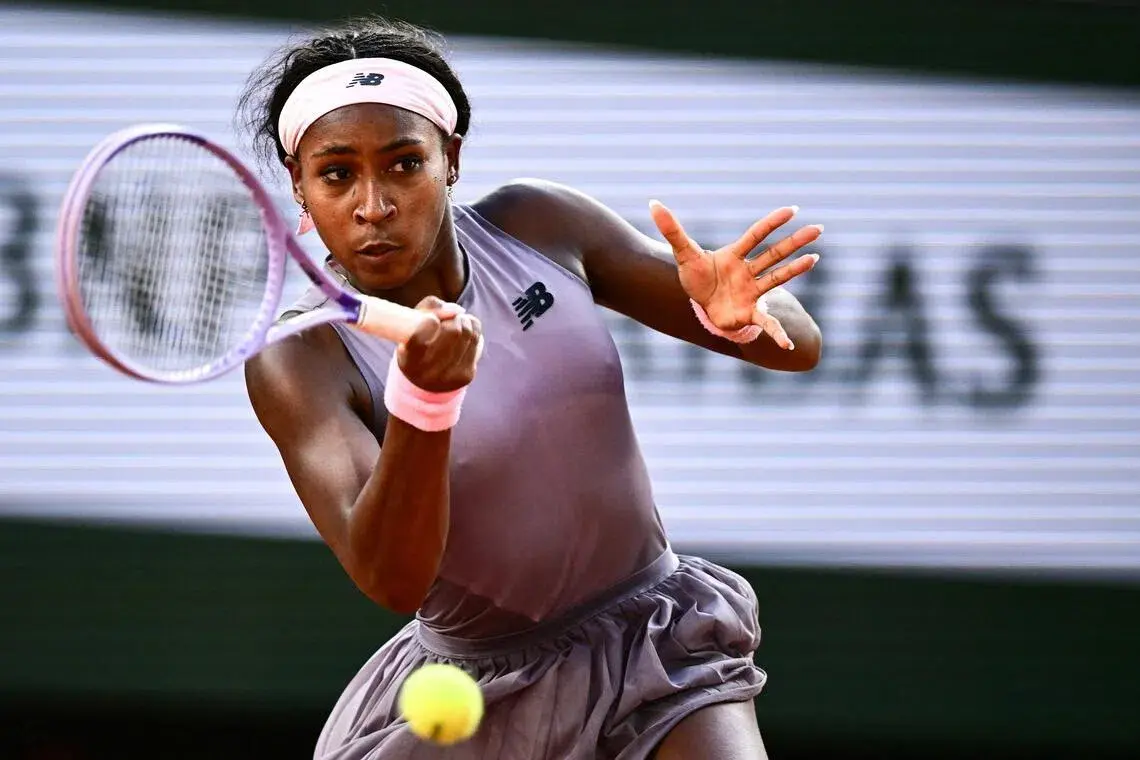
Reigning champion Coco Gauff’s French Open title defence came to an abrupt end in the third round on May 30, as she fell to Austrian 28th seed Anastasia Potapova 4-6, 7-6 (7/1), 6-4. The defeat marks Gauff’s earliest exit at Roland Garros since her debut six years ago, a stark contrast to her triumphant run in 2024 when she captured her first major title on the Parisian clay.
Gauff, the fourth seed and a two-time Grand Slam winner, had been a break up in the deciding set before Potapova stormed back, winning five of the next six games. The American’s serve, usually a weapon, faltered at key moments, including a double fault on break point in the final game. Despite the disappointment, Gauff said the pressure of defending a title did not affect her as it had at the 2024 US Open. “I think at the US Open it did a lot more but honestly this time it didn’t. I wasn’t really nervous,” Gauff explained. “That’s what’s more frustrating because I felt like I learned a lot from that US Open experience and I’m a better player since then and I just don’t think I portrayed that today.”
Potapova, who had lost her previous three matches against Gauff, described the victory as one of the top three of her career. She will next face 22nd seed Anna Kalinskaya for a place in the quarter-finals. The win also equaled Potapova’s best Grand Slam performance, having reached the fourth round at Roland Garros in 2023.
While Gauff’s exit stunned the tennis world, top seed Aryna Sabalenka continued her dominant run, dispatching Australia’s Daria Kasatkina 6-0, 7-5 in just 76 minutes. Sabalenka, the world number one, raced through the first set before facing a brief stumble in the second, going down an early break. However, the Belarusian’s power and precision proved too much, as she broke back and closed out the match. Sabalenka’s victory sets up a blockbuster fourth-round clash with fellow quadruple major winner Naomi Osaka.
Osaka, the Japanese 16th seed, battled past American teenager Iva Jovic 7-6 (7/5), 6-7 (3/7), 6-4 in a grueling three-setter. The former world number one showed resilience, saving break points and fighting through a second-set tiebreak loss to close out the match. Osaka, who has won two Australian Opens and two US Opens, has never reached the fourth round at Roland Garros before. “I was a lot calmer than in my first matches... In a Slam the further I get the calmer I am. It such an honour to be here. It’s the furthest I have ever been here,” Osaka said. Her calmness under pressure will be tested against Sabalenka, who has beaten her twice this season. Their only previous Grand Slam meeting came at the 2018 US Open, where Osaka won en route to her first major title.
Sabalenka, also 28, has been in formidable form on clay, winning the Madrid Open earlier this year. She expressed readiness for the challenge: “I’m just ready for the fight. I’m ready to go out there to fight for that match, for that win. Ready to do anything it takes to get the win.” The clash between two powerful baseliners promises to be a highlight of the tournament, with both players possessing the ability to dictate play from the baseline.
The women’s draw saw further upsets as sixth seed Amanda Anisimova fell to France’s Diane Parry in a third-set tiebreak. Anisimova, who reached the semi-finals here in 2024, could not find her rhythm against the home favourite. Parry’s win electrified the French crowd, who cheered her every point. The American’s exit leaves the top half of the draw wide open, with Sabalenka and Osaka now the clear favourites to reach the final.
On the men’s side, the tournament has been rocked by the early departures of top seed Jannik Sinner and 24-time major winner Novak Djokovic. Their absence has created a golden opportunity for the remaining players. Italian 10th seed Flavio Cobolli made a statement by crushing Learner Tien 6-2, 6-2, 6-3 in just one hour and 45 minutes. Cobolli, who has been steadily rising in the rankings, is aware of the opportunity but remains focused. “I know that... for sure we (will) have a new Grand Slam champion, but I don’t want to think about this. For sure I have now another tough match,” he said. He will next face Zachary Svajda, the American world number 85 who upset 25th seed Francisco Cerundolo. Svajda’s run is the best of his career at a major.
The Cerundolo family has had mixed fortunes. Francisco’s brother, Juan Manuel Cerundolo, who famously beat Sinner in the second round, endured a marathon five-set victory over Martin Landaluce that lasted nearly six hours. The match, which ended 7-6 (7/3), 5-7, 6-7 (4/7), 6-4, 7-6 (15/13), tested both players’ physical and mental limits. Juan Manuel will next face former Wimbledon finalist Matteo Berrettini, who also had a long battle, spending five hours and 13 minutes to overcome Francisco Comesana 7-6 (7/3), 5-7, 6-7 (4/7), 6-4, 7-6 (15/13). Berrettini’s serve and forehand remain potent, but fatigue could be a factor.
Other notable matches include French wildcard Moise Kouame, who saw his fairytale run end in four sets against Chile’s Alejandro Tabilo. The 17-year-old Kouame, ranked outside the top 700, had captured the imagination of the home fans but ultimately lacked the experience to challenge Tabilo. In the night session, Canadian fourth seed Felix Auger-Aliassime faced Brandon Nakashima in a match that could shape the quarter-final lineup. Auger-Aliassime, who has reached the semi-finals at Roland Garros previously, is considered one of the top contenders in the weakened draw.
The French Open has always been a tournament of surprises, but the 2025 edition has been particularly chaotic. The women’s draw lost its defending champion early, while the men’s draw has seen the top two seeds exit before the third round. This opens the door for lesser-known players to make deep runs. Italian players have been especially prominent, with Cobolli, Berrettini, and others advancing. The next few days will determine who can seize the opportunity.
As the tournament progresses, the matches become only more intense. Sabalenka vs Osaka is a mouth-watering prospect, pitting two of the most explosive hitters in the game against each other. On the men’s side, the lack of a clear favourite means every match is unpredictable. Fans can expect more marathon sets and dramatic tiebreaks, as players push themselves to the limit in pursuit of Grand Slam glory.
The conditions at Roland Garros have been challenging, with cool temperatures and occasional rain affecting the schedule. However, the clay courts have played true, rewarding players with sound technique and tactical nous. The surface, traditionally slower than grass or hard courts, demands patience and stamina, qualities that have been on full display. Potapova’s win over Gauff showcased her improved movement and shot selection, while Sabalenka’s raw power overwhelmed Kasatkina. Osaka’s victory underscored her growing comfort on clay, a surface that once troubled her.
The match between Gauff and Potapova was a microcosm of Gauff’s season: brilliant flashes mixed with inconsistency. After winning the US Open in 2024, Gauff struggled to maintain that level, often being outplayed by opponents who exploited her second serve. Her forehand, once a weakness, has improved, but it still breaks down under pressure. Potapova, meanwhile, has quietly built a solid career, and her win over Gauff signals that she is ready to challenge the elite. Her reward is a meeting with Kalinskaya, another talented Russian who has been in good form.
In the larger context, the women’s tour is experiencing a transition. With Serena Williams retired and other veterans like Victoria Azarenka and Petra Kvitova nearing the end, a new generation led by Gauff, Sabalenka, and Osaka is taking over. Sabalenka has been the most consistent player over the past two years, winning multiple titles and reaching number one. Osaka, after a difficult period with injuries and personal issues, is rediscovering her love for the game. Their rivalry, though not as storied as some, has the potential to define the next era of women’s tennis.
The men’s tour is also in flux. The absence of Djokovic, Sinner, and Carlos Alcaraz (who is also out due to injury) leaves a void that many players are eager to fill. Cobolli, Auger-Aliassime, and Berrettini are among those with the game to win a major, but they must prove they can handle the pressure. The French Open has historically been the most difficult Grand Slam to win, with its grueling rallies and mental demands. This year, the champion will likely be someone who has not previously won a major, adding to the excitement.
As the fourth round approaches, the matches become more compelling. Sabalenka and Osaka will likely be the centrepiece, but the other women’s matches also feature intriguing storylines. On the men’s side, the Cerundolo-Berrettini clash could be another epic, while Cobolli seeks to continue his march. The tournament is wide open, and every player knows that this is their best chance to etch their name into tennis history.
The French Open continues to deliver drama, heartbreak, and exhilaration. Gauff’s exit is a reminder that defending a title is never easy, while Sabalenka and Osaka’s progress highlights the relentless competitiveness of the sport. With the second week underway, the stage is set for memories that will last a lifetime.
Source:The Straits Times News