

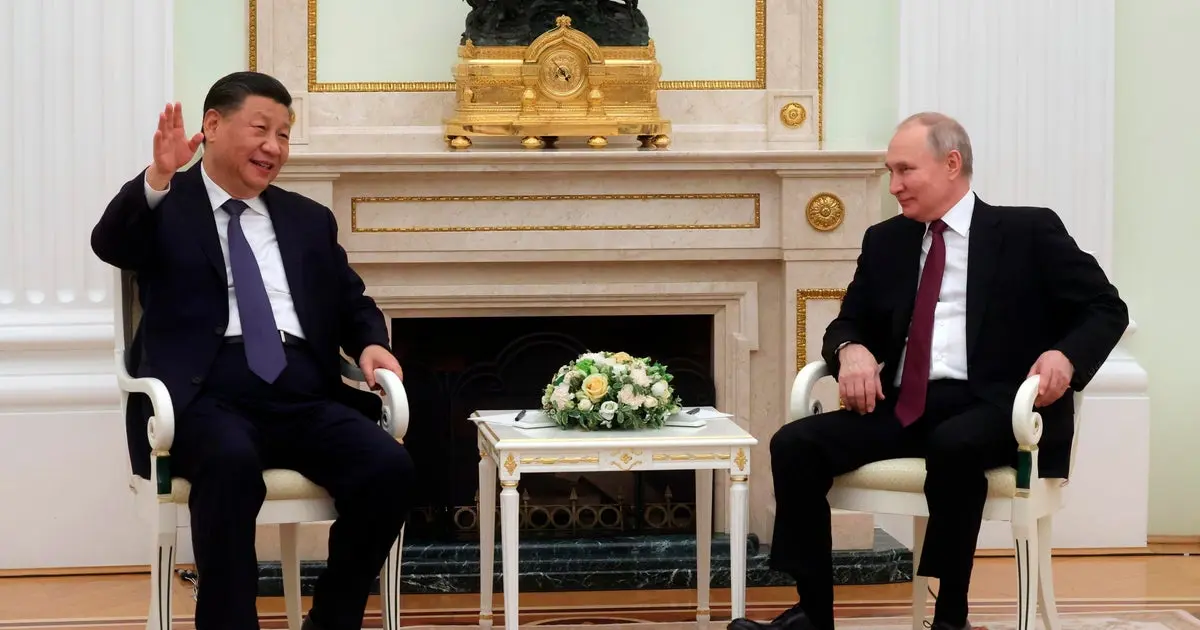
Russian President Vladimir Putin is set to visit Beijing next week for a two-day summit with Chinese leader Xi Jinping, the Kremlin announced Saturday. The meeting, scheduled for May 19-20, comes less than 24 hours after U.S. President Donald Trump concluded his own state visit to China, where he met with Xi to discuss trade and the war in Iran.
According to the Kremlin, Putin and Xi will discuss bilateral relations, economic cooperation, and "key international and regional issues." The trip coincides with the 25th anniversary of the 2001 Sino-Russian Treaty of Friendship, a cornerstone of the strategic partnership between the two nations. Following the talks, a joint statement "at the highest level" and several bilateral intergovernmental, interdepartmental, and other documents are expected to be signed.
The announcement highlights the deepening ties between China and Russia, which have grown significantly since Russia's full-scale invasion of Ukraine in February 2022. Western sanctions have isolated Moscow economically and diplomatically, pushing it to rely heavily on Beijing for trade and investment. In return, China has positioned itself as a neutral party but has strengthened its economic and military cooperation with Russia, buying discounted energy and increasing bilateral trade volumes.
Putin and Xi have met multiple times in recent years, with each declaring the other as an "old friend." In September 2025, during Putin's previous visit to China, Xi warmly welcomed him, and the two leaders emphasized their shared vision for a multipolar world order that challenges U.S. dominance. The upcoming meeting is also expected to reaffirm their alignment on issues such as opposition to NATO expansion, support for the United Nations' central role, and promotion of the Belt and Road Initiative.
The timing of Putin's trip is significant, coming just after Trump's summit in Beijing. Trump touted his visit as a success, claiming Chinese officials opened doors to new areas of cooperation. However, concrete agreements have yet to materialize. Experts told CBS News that Trump failed to secure any breakthrough trade deals. Wendy Cutler, a former negotiator in the Office of the U.S. Trade Representative, said, "So far, it doesn't seem like Trump and his team have a lot to show for the visit."
Questions about U.S. aid to Taiwan also lingered after Trump's summit. The president has not decided whether to move forward with a delayed $14 billion arms sale to Taiwan that Congress approved in January. Leaders from both parties urged Trump to support the island territory, adding tension to U.S.-China relations. China considers Taiwan a breakaway province and has repeatedly warned against any official U.S. engagement with Taipei.
On Saturday, Trump posted two photos of himself and Xi on Truth Social, calling it "A Great Honor to be with a Leader who is respected by all!" One image shows them walking on a red carpet past saluting service members; another shows a handshake. The posts reflected Trump's admiration for Xi, but analysts note that the lack of concrete outcomes weakens his negotiating position. The U.S. trade deficit with China remains large, and tariffs imposed during Trump's first term were largely kept in place by the Biden administration—though Trump has promised to renegotiate.
Putin's visit to Beijing is part of a broader pattern of high-level exchanges between Russia and China. The two countries have conducted joint military exercises, increased energy deals, and coordinated on issues like the situation in Ukraine and the Indo-Pacific. The West has watched these moves anxiously, with some officials warning that China's support for Russia undermines sanctions and prolongs the war. Beijing insists it is neutral and calls for a peaceful resolution, but it has not condemned Russia's actions and continues to buy Russian oil and gas at discounted prices.
Economic ties between China and Russia have flourished. Bilateral trade reached a record $240 billion in 2024, with China exporting electronics, machinery, and consumer goods, and importing energy and agricultural products. China has become Russia's largest trading partner, while Russia is China's top supplier of crude oil and natural gas. The two nations have also worked to reduce reliance on the U.S. dollar, settling more transactions in yuan and rubles. In March 2023, during Xi's visit to Moscow, the leaders signed agreements to deepen cooperation in finance, energy, and technology.
The upcoming summit will also touch on regional issues, including the Korean Peninsula, Afghanistan, and the Middle East. Both Russia and China have called for a ceasefire in Gaza and have criticized Israeli actions, while also maintaining ties with Iran. The war in Ukraine will likely dominate discussions, with Xi expected to reiterate China's 12-point peace plan, which calls for respect for territorial integrity and an end to sanctions—points that align closely with Russian interests. Putin may also brief Xi on the latest battlefield developments and seek support for a negotiated settlement favorable to Moscow.
Furthermore, the summit comes as China prepares to host the Asia-Pacific Economic Cooperation (APEC) summit in Shenzhen in November, where Putin is also scheduled to attend. This gives both leaders an opportunity to coordinate their messaging on trade liberalization and regional integration, while also underscoring their growing influence in the Asia-Pacific region at a time when the U.S. is pushing its own Indo-Pacific strategy, including the Quad (U.S., Japan, India, Australia) and AUKUS.
The symbolism of the back-to-back summits is not lost on observers. Trump's visit, while marked by warm personal rapport, failed to produce substantive results, whereas Putin's trip is expected to yield multiple agreements and a joint statement. This contrast highlights the shifting geopolitical landscape: the U.S. struggles to maintain its position as the dominant power in Asia, while Chinese and Russian leaders present a united front. For Washington, the challenge is to counter the growing alignment without triggering a new Cold War. For Beijing and Moscow, the goal is to accelerate the transition to a multipolar order where their voices carry equal weight.
As Putin arrives in Beijing, the world will be watching for signs of a deeper partnership. The two leaders are expected to hold a joint press conference, and the documents signed could cover everything from space exploration to railway connectivity. The meeting will also set the stage for future engagements, including a potential state visit by Xi to Moscow later this year and the BRICS summit in Russia in 2026. In an era of global uncertainty, the Russia-China axis is becoming more defined—and more consequential.
Source:Cbsnews News