

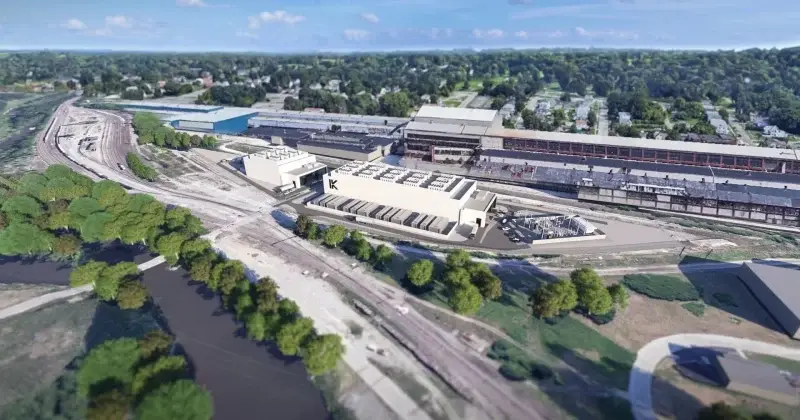
Keel Infrastructure, the company that previously operated as Bitfarms, has posted a staggering $145 million net loss for the first quarter of 2026. The financial results underscore the challenges of a sweeping transformation as the firm abandons Bitcoin mining in favor of artificial intelligence (AI) and high-performance computing (HPC) infrastructure.
Financial highlights and challenges
Revenue for the quarter fell 23% year-over-year to $37 million, down from $48 million in the same period last year. The net loss of $145 million was driven by several one-time factors. A $41 million decrease in the fair value of digital assets contributed significantly to the red ink. The company also absorbed $22 million in costs related to exiting a credit facility. Additionally, expenses tied to pulling out of Latin American operations entirely, including the sale of its Paso Pe site in Paraguay on April 21, 2026, weighed on the bottom line.
Adjusted EBITDA came in at negative $17 million for the quarter. On a per-share basis, the loss worked out to $0.21, missing analyst expectations by roughly 400%. Between January 1 and May 8, 2026, the company sold 269 Bitcoin for approximately $20 million.
The pivot from pickaxes to processors
The strategic transformation began in 2025, when the company started shifting its operational base to the United States and initiated the rebranding process. The name change from Bitfarms to Keel Infrastructure was the final symbolic step. The company has assembled a 2.2 gigawatt HPC and AI development pipeline across North America, concentrated in Pennsylvania, Washington, and Québec.
“Our rebranding to Keel Infrastructure marks the completion of a nearly two-year strategic transformation,” CEO Ben Gagnon said. Gagnon has expressed optimism about advancing key HPC and AI project sites through the remainder of 2026.
Why the industry is making this move
The 2024 Bitcoin halving sliced block rewards in half, compressing margins for miners across the board. Former Bitcoin miners are increasingly repurposing their infrastructure to chase AI compute demand, and Keel is arguably the most aggressive example, having essentially bet the entire company on the transition. The company’s liquidity position provides some comfort here. As of May 8, 2026, Keel reported $533 million in total liquidity, including $197 million in unencumbered Bitcoin.
The sale of the Paraguay site and the broader Latin American withdrawal signal that Keel is consolidating its geographic footprint on North American HPC development. The shift reflects a broader trend in the cryptocurrency mining industry, where many firms are diversifying into AI and HPC to capture higher margins and more predictable revenue streams.
What this means for investors
A $533 million liquidity cushion buys time, and much of the $145 million loss stems from one-time costs associated with unwinding the old business model. A 23% year-over-year revenue decline reflects the drawdown of mining operations without HPC revenue yet filling the gap. Investors are essentially being asked to accept near-term losses in exchange for future AI-driven revenue streams that haven’t materialized yet.
For crypto-focused investors, Keel’s $197 million in unencumbered Bitcoin represents significant ongoing exposure to Bitcoin’s price, even as it walks away from mining it. A sustained Bitcoin rally could improve the balance sheet; a downturn could accelerate the need to liquidate holdings to fund HPC development. Analysts remain divided on the viability of the strategy, but Keel’s aggressive pivot highlights the intense competition for AI compute capacity in North America.
Background on the transformation
Keel Infrastructure was originally founded as Bitfarms in 2017, growing into one of the largest publicly traded Bitcoin mining companies in North America. The company operated mining facilities in Canada, the United States, and Paraguay, with a focus on low-cost hydropower. However, the 2024 halving and increasing mining difficulty reduced profitability, prompting management to explore alternative uses for its energy infrastructure.
HPC and AI workloads require large amounts of reliable, low-cost electricity—exactly what mining farms were built for. By repurposing existing facilities, Keel can accelerate deployment and reduce capital expenditures compared to building from scratch. The company’s 2.2 GW pipeline includes both greenfield projects and conversions of former mining sites. Partnerships with chip manufacturers and cloud providers are expected to be announced later in 2026.
The decision to exit Latin America reflects a strategic focus on jurisdictions with stable regulatory environments and strong demand for AI services. Paraguay had been a key mining hub due to cheap hydroelectric power, but the operational complexity and geopolitical risks outweighed the benefits for Keel’s new direction.
As of mid-2026, the company has not yet recognized any revenue from HPC or AI services. The transition timeline depends on construction permitting, equipment delivery, and customer contracting. Gagnon has indicated that the first revenue-generating HPC sites could come online in the second half of 2026, with full build-out expected by 2028.
Competitors such as Hut 8, Riot Platforms, and Core Scientific have also announced AI and HPC initiatives, but Keel’s decision to completely abandon Bitcoin mining is among the most radical. The risk is that if AI demand falters or if competition drives down margins, Keel may have abandoned a proven business model for an unproven one. However, the current AI boom—driven by large language models, autonomous systems, and scientific computing—shows no signs of slowing, and power availability remains a key bottleneck for hyperscalers.
For investors, the key metrics to watch will be capital expenditures, customer announcements, and the pace of site development. The $533 million liquidity provides a buffer, but if delays push revenue into 2027, further dilution or asset sales may be necessary. The company’s unencumbered Bitcoin also acts as a hedge but adds volatility to the balance sheet.
The broader crypto-mining industry is watching Keel’s experiment closely. If successful, it could trigger a wave of similar pivots; if it fails, it may discourage other miners from abandoning their core business. Either way, Keel Infrastructure has become a bellwether for the convergence of crypto and AI infrastructure.
Source:Crypto Briefing News