

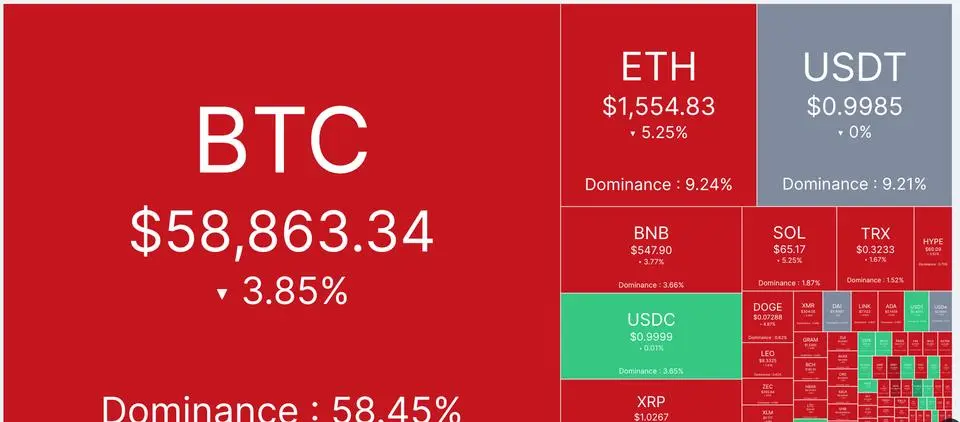
The cryptocurrency market continued its cautious descent on June 25, with bitcoin settling below the psychologically important $60,000 level for the first extended period in recent weeks. After briefly touching $59,175 overnight, the largest digital asset by market capitalization recovered to around $61,500 by late afternoon but ultimately closed the U.S. trading session near $59,500, essentially flat over 24 hours. The movement came amid a mix of macroeconomic pressures, sector-specific news, and evolving market narratives that are reshaping investor sentiment.
Bitcoin's Stubborn Hold Below $60,000
Unlike earlier brief dips below $60,000 during this bear market, bitcoin now appears to be settling in comfortably under that threshold, having spent a considerable portion of the last two days below it. The price action reflects a market that is grappling with multiple headwinds: persistent outflows from spot bitcoin ETFs, a hawkish Federal Reserve that has priced in two rate hikes over the next eight months, and thinning summer liquidity. The quarter-end options expiry on June 30 is also adding to instability, with traders pointing to large open interest clusters near $58,000 that, if broken, could trigger a wave of liquidations.
Major market maker Wintermute had flagged $59,000 as a key bear-market low to watch in its Tuesday note. That level held during the overnight dip, providing some technical support. However, approximately $1.6 billion in leveraged long positions sit clustered below $58,000, according to CoinGlass, meaning a break below that mark would accelerate the drop. The bounce from the overnight low was largely attributed to positive earnings from Micron Technology, which lifted the broader AI chip complex and rippled into crypto markets.
Micron's Earnings Surge and the AI-Crypto Capital Flow
Micron Technology reported quarterly earnings after the close on June 24 that shattered analyst estimates, sending its shares sharply higher by more than 12% on June 25. The memory chip maker's strong performance lifted the entire semiconductor sector, including SK Hynix, Samsung, and Kioxia. SK Hynix separately disclosed plans for a U.S. stock listing seeking roughly $29 billion, one of the largest offerings ever. The same AI chip trade that had sent South Korea's Kospi down 10% on Monday on fears that the spending boom was stalling now became the force steadying crypto markets. Micron's results confirmed that demand for AI memory is structural, not speculative, providing a macro tailwind that helped lift bitcoin off its lows.
The intersection between AI and crypto has been a recurring theme. Many market participants note that the flood of investor interest into AI stocks has left crypto starved of capital. Memory chip prices have surged so much that consumers of those chips, including major tech companies like Nvidia, Apple, Microsoft, Google, and Amazon, are feeling the sting. On June 25, these companies were all sharply lower as Micron soared, a pattern that market technician J.C. Parets highlighted as the 'Lag 7' notching a new 52-week low versus the S&P 500. This decoupling suggests that capital rotation away from mega-cap tech into AI-related hardware could eventually benefit crypto if the narrative broadens.
OpenAI Mulling Delaying IPO Until 2027
In a separate development that underscores the cautious sentiment across tech and crypto, OpenAI, led by Sam Altman, is reportedly leaning toward delaying its initial public offering until 2027. Previously eyeing an IPO in the second half of 2026, the company's executives are reconsidering their plans due to the recent dip in Elon Musk's SpaceX following its mega-IPO, as well as general choppiness in markets. This delay reflects the broader uncertainty that is also affecting crypto valuations. A delayed IPO for OpenAI means less immediate liquidity for its investors and less enthusiasm for new tech listings, which could indirectly dampen risk appetite for crypto assets.
Coinbase CEO Brian Armstrong Weighs In on the Four-Year Cycle
The four-year cycle theory continues to dominate discussions among crypto analysts and enthusiasts. Bitcoin's price action in 2026 is closely matching the patterns seen in 2014, 2018, and 2022, leading many to believe that the current bear market is just the next iteration of the network's halving-driven cycle. The cycle typically begins a major bull run in the year following a halving, then peaks, and bottoms about 12 to 13 months later. That timeline would point to a bottom around October 2026. Coinbase CEO Brian Armstrong recently acknowledged this view in a social media exchange, replying 'Yep' to a post that described the pattern as 'super sad' for investors but ultimately healthy for the market.
Critics of the four-year cycle argue that with over 19 million bitcoin already in circulation, the halving events now have very little effect on supply and thus should not significantly affect price. Nonetheless, the epoch that began in April 2024 is playing out largely as cycle proponents expected. The debate continues, but the market's current behavior gives credence to those who see bitcoin's boom-and-bust rhythm as a structural feature, not a bug.
Strategy's STRC Not Next Luna, Arkham Assures
Concerns about Strategy's preferred stock STRC have been rising alongside the company's common stock MSTR, which hit a multi-year low of $87 on June 25. STRC itself reached a record low of $76.70. However, analysis from Arkham Intelligence provided a counterpoint to fears that Strategy could face a liquidation event similar to Terra Luna. Arkham reminded investors that Strategy does not legally have to pay dividends on STRC. Unlike Terra Luna, where algorithmic mechanisms forced liquidation, Strategy's dividend payments are discretionary. If the company faces financial strain, it can simply stop paying dividends without triggering a forced sell-off of its nearly 850,000 bitcoin holdings. While this scenario would be negative for both common and preferred shareholders, it illustrates that there is little to no chance of a catastrophic liquidation that would dump bitcoin onto the market.
Apple Hikes Prices Across the Board
Apple has increased prices across its Mac and iPad lineup by roughly 15% to 25%, citing rising memory and storage chip costs. The move follows CEO Tim Cook's warning that sharp increases in component costs would likely force price adjustments. iPhone prices remained unchanged for now, but Apple signaled further increases could follow. This development is relevant to crypto markets because it highlights the inflationary pressures that the Fed is trying to combat. Higher consumer prices keep the central bank on a hawkish path, which in turn strengthens the U.S. dollar and weighs on risk assets like bitcoin.
IREN Inks Multi-Year Golden State Warriors Jersey Deal
IREN, a cryptocurrency mining and AI infrastructure company, has signed a multiyear jersey sponsorship agreement with the Golden State Warriors. The deal replaces Rakuten Group Inc., which had held the NBA team's uniform patch rights since 2017. IREN's chief commercial officer Mike Kitts told Bloomberg that the Warriors 'sit in the AI capital of the world' and that the AI space was 'really, really interesting' for the company. Financial terms were not disclosed. The partnership reflects the growing intersection between crypto mining, AI compute, and mainstream sports sponsorships, though IREN's shares were down 3% on the day, suggesting investor skepticism remains high.
PCE Inflation Data Meets Expectations, Fed Holds Course
The highly anticipated U.S. core PCE data for June 25 came in exactly as expected: 0.3% month-over-month and 3.4% year-over-year. Headline PCE printed slightly cooler at 0.4% month-over-month and 4.1% year-over-year. The data confirmed stickiness in inflation, keeping expectations for two Federal Reserve rate hikes largely unchanged. However, the fact that it met estimates ensured no additional hawkish shock to the market. Bitcoin held steady above $61,000 immediately after the release, while gold remained below $4,000 per ounce. Stronger-than-expected U.S. GDP growth and personal income data reinforced the resilience of the economy, but also added to the narrative that the Fed has room to keep rates higher for longer.
Gnosis X Account Hacked With Fake Rewards Link
The official Gnosis X account was compromised early in the U.S. trading session and used to post a fraudulent message inviting users to vote on a rewards date with a link to check eligibility. Gnosis Pay, a separate related account, warned users not to interact with the post or link. The Gnosis team acknowledged the hack and urged the community to report the post while they work to recover the account. The incident is another reminder of the persistent threat of wallet-draining scams that use compromised project accounts to push fake reward links, creating urgency and tying into real project events to lure victims into connecting their wallets.
Spot Bitcoin ETF Flows Retreat to Lowest Cumulative Level Since July 2025
Bitcoin's brief drop below $60,000 coincided with $469 million in net outflows from U.S. spot bitcoin ETFs on June 24, marking the 30th largest single-day redemption since the funds launched in January 2024. As a result of consistent outflows over the past few months, cumulative net inflows have fallen to $52.8 billion, a level last seen on July 14, 2025. That is approximately $2.3 billion below the peak reached a few days later. The outflows are a significant headwind for bitcoin price, as institutional demand through ETFs was a major driver of the 2024 bull run. Without fresh inflows, the market lacks a key catalyst.
Two-Year Treasury Yield on the Cusp of a Major Breakout
The U.S. two-year Treasury yield is testing a descending trendline that has capped its decline since the October 2023 peak of 5.26%. A decisive move above this trendline would signal a classic bullish breakout for yields, implying tighter financial conditions. Such a development would likely support a stronger U.S. dollar while exerting downward pressure on risk assets, including bitcoin and equities. The two-year yield is highly sensitive to near-term interest rate expectations, so its movement is closely watched by crypto traders as a leading indicator of Fed policy impact.
Oil Erases Nearly All Wartime Gains
Brent crude fell below $72.48 a barrel on June 25, wiping out every gain made since the U.S.-Iran war began, as tankers resumed open passage through the Strait of Hormuz and oil markets flooded with supply. West Texas Intermediate traded near $69. Cheaper oil eases inflation pressure that has pushed the Fed hawkish, and a sustained drop could eventually shift the rate outlook that has weighed on bitcoin all month. The chain runs oil lower, then inflation softer, then Fed less hawkish, then risk assets get room to recover. However, that sequence works with a lag of months, not days, so the oil move is a tailwind in the making rather than one that has arrived.
Aave Jumps 15% on Standard Chartered Bull Case
Aave's AAVE token surged about 15% in the past 24 hours to around $80 after Standard Chartered initiated coverage with a $3,500 price target for end-2030, roughly 50 times where the token traded when the note landed. Geoff Kendrick, the bank's global head of digital assets research, also put a $100 target on Uniswap's UNI token last week. His Aave thesis rests on the protocol recovering its dominant position in decentralized lending as the broader DeFi market grows, with assets across the sector projected to expand roughly 37 times by 2030. Kendrick sees AAVE reaching $180 by year-end before climbing in stages to $600, $1,200, and $2,200 over the following three years. However, Aave has had a rough stretch: a $291 million exploit at lending platform KelpDAO in April spilled into Aave, triggering a liquidity crunch that cut deposits from $44 billion to about $23 billion and pushed Aave's DeFi lending market share from 59% down to 38%. The bull case depends on unproven steps like Aave Horizon, and the 2030 target requires the token to go five times past its all-time high of $661 set in 2021, which drew some criticism over methodology.
As the trading day wound down, bitcoin remained in a tight range near $59,500, with the market bracing for the quarter-end options expiry and watching for further PCE and GDP data that could shift the Fed's trajectory. The interplay between AI chip stocks, ETF flows, and macroeconomic forces continues to define the crypto narrative, with no clear catalyst to break the current stalemate.
Source:Coindesk News