

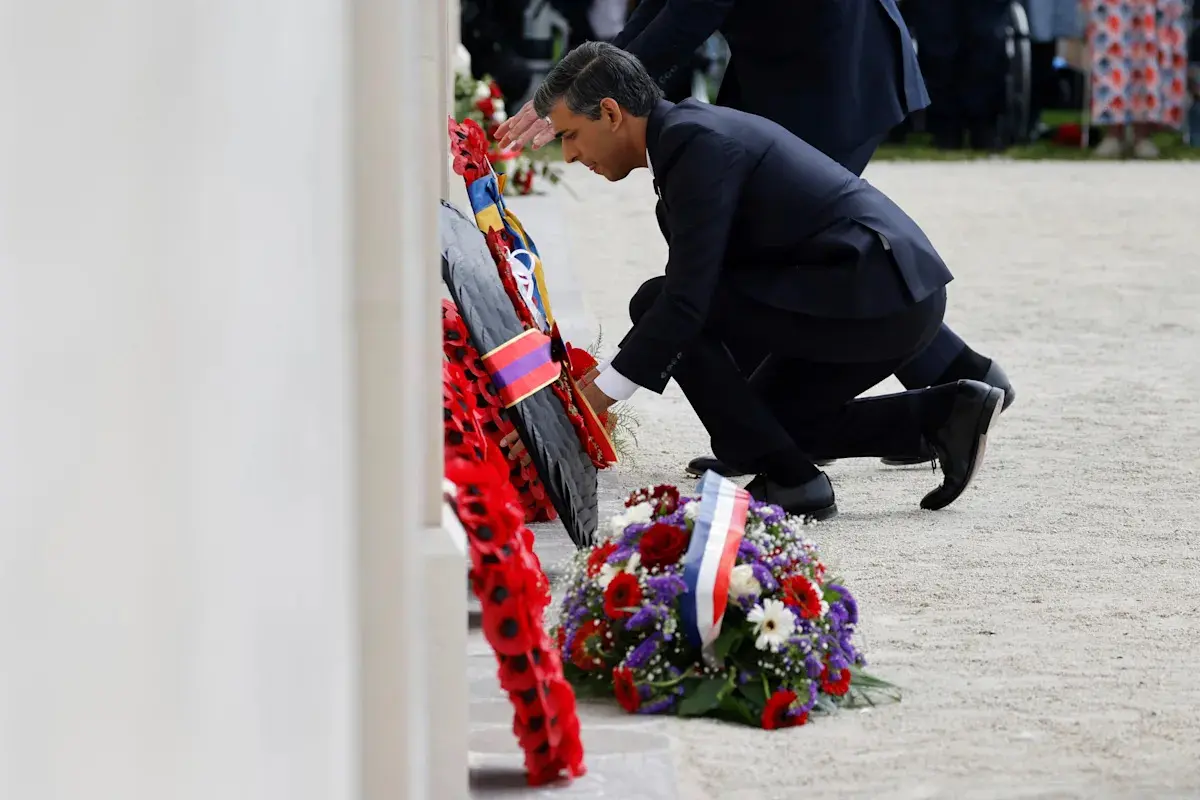
Sunak's Apology and Context
British Prime Minister Rishi Sunak apologized on Friday for leaving the 80th anniversary D-Day commemorations in France early to return to the election campaign trail, a decision that drew sharp condemnation from political rivals and even members of his own Conservative Party. Sunak acknowledged that, “on reflection,” his decision to depart from Normandy before the major international event at Omaha Beach was a mistake.
Sunak had attended a ceremony at the British Normandy Memorial on Thursday alongside King Charles III and surviving World War II veterans, as well as a commemoration in Portsmouth, England, the day before. However, he missed the headline gathering with President Joe Biden, French President Emmanuel Macron, German Chancellor Olaf Scholz, and Ukrainian President Volodymyr Zelenskyy. Foreign Secretary David Cameron, a former prime minister, represented the United Kingdom at that event.
In a post on X (formerly Twitter), Sunak said that the 80th anniversary of the Allied invasion that helped liberate Europe from Nazi control “should be about those who made the ultimate sacrifice for our country. The last thing I want is for the commemorations to be overshadowed by politics.” He added, “On reflection, it was a mistake not to stay in France longer — and I apologise.”
The prime minister also recorded an interview with broadcaster ITV after returning from France, though he insisted that was not the reason for his early departure. He claimed he “stuck to the itinerary” that had been arranged for D-Day weeks before he called the snap general election for July 4. “On reflection it was a mistake not to stay longer and I’ve apologized for that, but I also don’t think it’s right to be political in the midst of D-Day commemorations," he said. “The focus should rightly be on the veterans and their service and sacrifice for our country.”
Political and Public Backlash
The decision triggered immediate backlash from all major opposition parties. Labour leader Keir Starmer, who attended the full D-Day proceedings and was photographed meeting Zelenskyy and other leaders, stated that “Rishi Sunak will have to answer for his choice” to skip the ceremony. “For me there was only one choice. ... There was nowhere else I was going to be,” Starmer told broadcasters.
Liberal Democrat leader Ed Davey branded Sunak’s absence “a total dereliction of duty.” Meanwhile, in a BBC election debate featuring seven leading politicians (though neither Sunak nor Starmer participated), the controversy dominated the opening segment. Nigel Farage, leader of the populist Reform UK party, labeled Sunak an “unpatriotic prime minister.” Even Penny Mordaunt, a Conservative cabinet minister who is fighting to retain her seat in Portsmouth, expressed visible emotion, calling Sunak’s decision “completely wrong.” Mordaunt, a former defense secretary, said: “What happened was completely wrong and the prime minister has rightly apologized for that, apologized to veterans but also to all of us, because he was representing all of us. I’m from Portsmouth, I have also been defense secretary and my wish, at the end of this week, is that all of our veterans feel completely treasured.”
Political commentators widely interpreted the misstep as evidence that Sunak lacks the political instincts required of a prime minister. Craig Oliver, former communications director under David Cameron, remarked: “He’s accused of not getting what it is to be a prime minister and what his duties are as a prime minister.”
Veterans also expressed dismay. D-Day veteran Ken Hay, 98, told Sky News that Sunak’s decision to “bail out” had let the country down. “I don’t have a great regard for politicians,” Hay said.
Election Campaign Context
The incident occurs against the backdrop of a closely fought general election campaign. All 650 seats in the House of Commons are up for grabs on July 4. Sunak’s Conservative Party trails Labour in opinion polls, with Keir Starmer widely seen as the favorite to become the next prime minister. Sunak called the election earlier than expected, and the campaign has been marred by several gaffes and controversies, including accusations of lying about Labour’s tax plans—a clip from the ITV interview shows Sunak denying such claims.
The D-Day episode is a major blow to Sunak’s efforts to project statesmanship and competence. The 80th anniversary of the Normandy landings is a profoundly symbolic event in British national memory, and skipping a key part of it for a campaign interview—even if Sunak denies that was the reason—was seen by many as tone-deaf. The event in Britain commemorates the sacrifice of tens of thousands of soldiers on June 6, 1944, when Allied forces stormed the beaches of Normandy, marking the beginning of the end of World War II in Europe.
Historical Significance of D-Day
D-Day, the largest amphibious invasion in history, involved over 156,000 Allied troops landing on five beaches in Normandy, codenamed Utah, Omaha, Gold, Juno, and Sword. The operation was commanded by General Dwight D. Eisenhower and ultimately led to the liberation of France and the defeat of Nazi Germany. The 80th anniversary is especially poignant, as few veterans survive. Their presence at the ceremonies underscores the importance of respect and remembrance.
Sunak’s early departure therefore struck many as a profound misjudgment of the gravity of the occasion. Even within his own party, there was unease. Conservative MP Tobias Ellwood, a former defense minister, said on X: “The Prime Minister should have been at the international commemoration. It was not just a diplomatic error but a dereliction of the respect owed to those who gave their lives for our freedom.”
The political fallout continued over the weekend, with Labour and other parties using the incident to reinforce their message that Sunak is out of touch and unfit to lead. The Liberal Democrats ran a social media ad featuring a D-Day veteran with the caption: “Rishi Sunak couldn’t even make time for D-Day veterans. If he can’t respect our heroes, how can he be trusted to run our country?”
As the election approaches, Sunak will hope that voters focus on economic issues, NHS waiting lists, and immigration rather than this self-inflicted wound. But for a prime minister already struggling to gain traction, the D-Day controversy is a painful reminder of how quickly a campaign can go off the rails. The question now is whether the apology will be sufficient to contain the damage, or whether the memory of an empty chair at Omaha Beach will haunt him until July 4.
In a final note of irony, the BBC election debate on Friday saw almost unanimous condemnation of Sunak’s action—even from his own representative, Penny Mordaunt. The opposition parties, including those who might not otherwise agree on much, were united in their criticism. The image of a prime minister prioritizing the campaign trail over the hallowed ground of Normandy is likely to remain a defining moment of this election cycle.
Source:Yahoo News News