

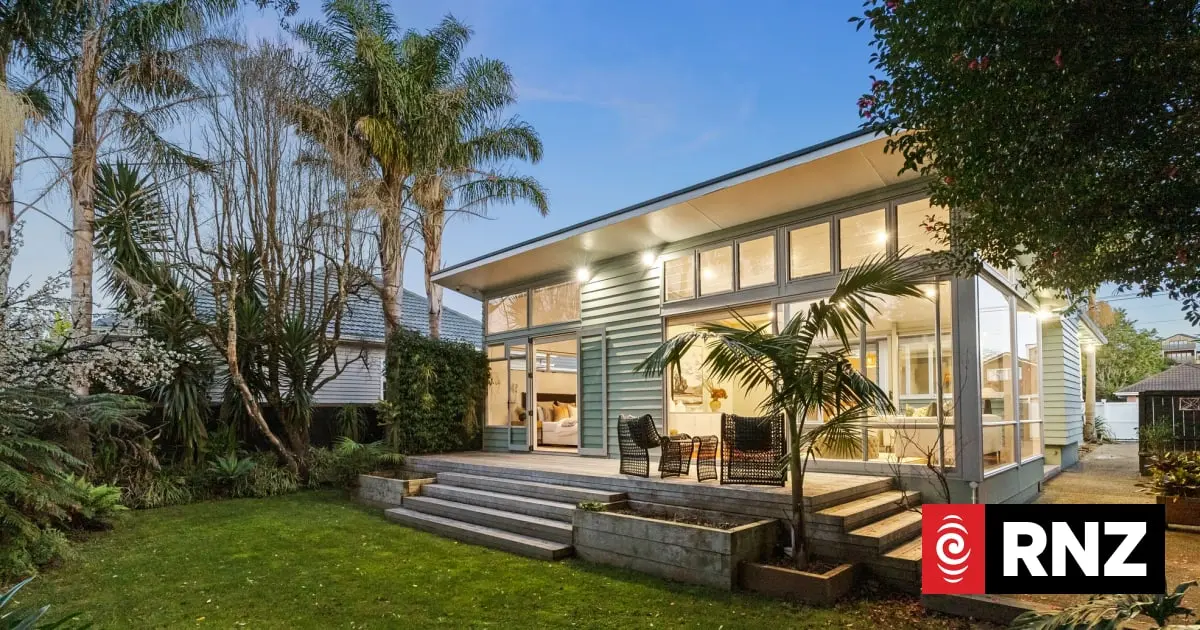
Dame Jacinda Ardern and her husband Clarke Gayford have put their Auckland family home on the market, marking another chapter in the former prime minister’s life as she continues to base herself and her family in Australia. The Sandringham property, a 1930s weatherboard bungalow with four bedrooms and two bathrooms, is listed for auction on 8 July through Ray White Kingsland.
The home, which the couple bought in 2018 for $1.74 million, has a current value of $2.21 million according to OneRoof. The listing describes it as “perfect for the daily rhythm of family life” and highlights its “traditional weatherboard charm” complemented by a modern extension. Set on a generous section in a quiet street, the house has been a family haven for Ardern, Gayford, and their daughter Neve Te Aroha, now eight years old.
Ardern’s decision to sell comes after several years of international travel and relocation. In February, a statement on her behalf noted that the family had been “travelling for a few years now” and that “for the moment they’re basing themselves out of Australia – they have work there, and it brings the added bonus of more time back home in New Zealand.” Reports have also emerged that Ardern has been house hunting in Sydney’s northern beaches suburbs, specifically looking at properties in Curl Curl and Freshwater.
The sale of the Sandringham home is more than a real estate transaction; it marks a symbolic shift for one of New Zealand’s most recognizable political figures. Ardern served as prime minister from 2017 to 2023, leading the country through some of its most challenging moments. She became the world’s youngest female head of government at age 37 and only the third woman to hold New Zealand’s top political office.
Her tenure was defined by a series of crises. In March 2019, she faced the Christchurch mosque shootings, which killed 51 people. Her response, which emphasized compassion and unity, was widely praised internationally. She swiftly moved to ban military-style semi-automatic weapons and led a national conversation about extremism and inclusion. Later that year, the Whakaari/White Island volcanic eruption claimed 22 lives, and Ardern’s government managed the complex response and recovery efforts.
The COVID-19 pandemic tested her leadership further. New Zealand adopted an elimination strategy that initially kept case numbers low, allowing life to return almost to normal for much of 2020. Ardern’s communication style—clear, empathetic, and data-driven—earned her respect both at home and abroad. However, as the pandemic wore on, the government faced criticism over lockdowns, vaccine mandates, and the eventual shift in strategy. The anti-mandate protests at Parliament in early 2022 were a particularly divisive episode.
On the policy front, Ardern advanced a “well-being budget” that prioritized mental health, child poverty reduction, and climate change action. She oversaw the creation of a Child Poverty Reduction Act and increased benefits to lift thousands of children out of poverty. Her government also passed the Zero Carbon Act, setting ambitious emissions reduction targets. Yet her coalition with New Zealand First and later the Conservatives constrained some of her government’s more progressive ambitions.
In February 2023, Ardern announced her resignation, saying she no longer had “enough left in the tank” to continue. She had won a second term in 2020 with a landslide majority but saw her popularity decline amid economic pressures and political fatigue. Her departure was met with an outpouring of emotion and tributes from world leaders. She left office as one of the most globally recognized figures in recent New Zealand history.
Since stepping down, Ardern has pursued academic and literary endeavors. She took up two fellowships at Harvard University, where she taught and studied leadership and digital governance. She also published a memoir, A Different Kind of Power, and a children’s book, Mum’s Busy Work. A documentary about her time in office, titled Prime Minister, won the top prize for best documentary at the 2026 News & Documentary Emmy Awards.
The family’s move to Australia reflects their current professional and personal priorities. Gayford, a television presenter and producer, has work commitments there, and the couple has expressed a desire to remain connected to New Zealand while enjoying the benefits of being closer to family across the Tasman. The Sandringham house has been a part of their life during the most intense period of Ardern’s career, and its sale signals a new phase.
Sandringham itself is a sought-after Auckland suburb, known for its diverse community, excellent cafes, and proximity to the city center. The area has seen significant property value growth, and the Ardern home’s sale is likely to attract considerable interest. The auction date of 8 July will be closely watched by real estate observers and political commentators alike.
For Ardern, the sale is a practical step as she continues to build a life beyond politics. She remains a figure of public fascination, and her post-premiership activities—from her Harvard fellowship to her Emmy-winning documentary—demonstrate her ability to transition from political leadership to other influential roles. The house in Sandringham, once the private retreat of a prime minister, will soon pass to new owners, but its story will remain intertwined with one of the most consequential periods in modern New Zealand history.
Source:RNZ News