

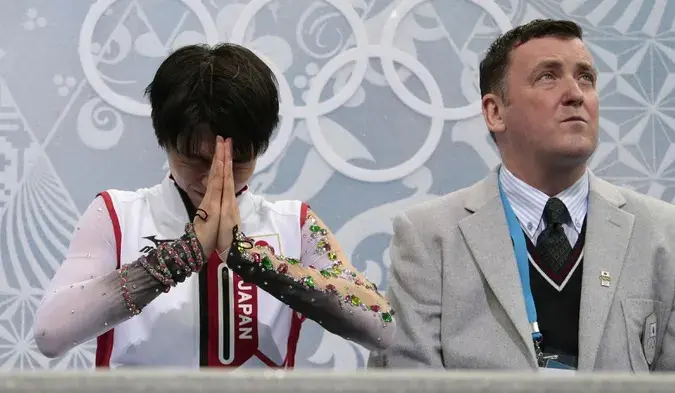
On a night where it seemed like the top two contenders, Patrick Chan and Yuzuru Hanyu, tried valiantly to give the gold medal away, it was eventually Hanyu who was crowned Olympic champion in men's figure skating. Usually, gold medals mean an athlete going above and beyond, delivering a once-in-a-lifetime performance (see: Douglas, Gabby). That did not happen on Friday. Instead we were treated to a bobble-fest. Here's how it went down.
The Lead
Going into the free skate, Japan's Hanyu had a 3.93-point lead over Canada's Chan thanks to his splendid and record-breaking short program. That is not insurmountable. But that's big enough of a cushion that if Hanyu skated cleanly, there would be nothing Chan could do no matter how well he skated.
The Scoring
We've kind of gone over scoring a bit now. If you're down with scoring, scroll down to the next section. If you're still here, the most important thing you need to know is that free skates are comprised of a component score (comprised mostly choreography, artistry, skating skills) and a technical score. The latter part is the tricky thing. The technical score of free skates are made up of 13 elements — a combination of spins, jumps, and combination jumps that all carry a base value. Skaters want to do every single one of those elements beautifully because judges have the power to penalize and take away points or reward skaters and add bonus points based on how well (for jumps skater get scored on the jump, the entry going into the jump, the speed, height, etc.) or how bad they performed those elements. These are called Grade of Execution scores and are capped at -3 and +3. Now, let's move on to Hanyu's performance.
Hanyu's Bobbles
Going into the free skate, if Hanyu hit his elements cleanly there'd be no way Chan, the only man within 14 points of him, would catch him. The whole entire figure skating-watching world, Hanyu included, knew this. He was skating right before Chan. And the pressure seemed to get to him — he did not skate anywhere near the level that he displayed in the team event and in Thursday's short program. He opened with one of his two quads, and, with a fall, also opened the door for Chan. The thing to notice here is that Hanyu received a -3 in his execution score. That brings down the base value of his jump (10.50), and all of a sudden his 4-point lead over Chan has dwindled. Further: falls, when butts hit the ice, it's counted as another point deduction from the total score.
Hanyu followed that up with another bobble, this one on much less difficult jump, the triple flip. In two messy jumps, Hanyu found himself out of control of his own destiny. At this point: Advantage Chan.
When We Thought Chan Was Getting Gold
With those two, glaring mistakes, the door was open for the world champion. The table was set for gold medal. And for a moment it looked like he was doing to slam that door on Hanyu's chances. Chan delivered a stunning quadruple toe-triple toe loop combination on his first jumping pass. A +3 GOE means the judges believe he couldn't have done that combination any better. What you're looking for here is the speed, the amount of ice covered, and the smooth and effortless landing. If he and Hanyu were skating simultaneously, this would have been the moment where his score passed Hanyu. At this point: Advantage Chan.
Where Chan Lost It
Chan did not execute any of his following jumps with the same beauty and grace as that combination. His flubbed his triple axel. And did the same on his quadruple toe loop. The easiest way to think of it at this point is that Hanyu has two glaring mistakes. And so does Chan. Chan even has the slim edge at this point, since he didn't mess up as poorly as Hanyu. But, Chan's woes continued this time on his double axel — the easiest jump of the night in his program. At this point: Advantage Hanyu.
How Hanyu Won It
The biggest factor in Hanyu's victory was in his ability to stop the bleeding better than Chan. Despite a fall on his opening jump, he pulled it together for a pretty quadruple toe loop. Notice the 2.14 GOE — a sign that judges thought this jump was exceptional. And his triple axel-triple toe loop combination was also exquisite. And again, another stellar 2.43 GOE and another boatload of points. These jumps, and Hanyu's ability to hold it together, were part of the reason Hanyu kept his first place spot despite skating a flawed program. The other part was Chan's inability to keep it together. Thanks to Chan's mistakes, Hanyu actually extended his lead over Chan by another 1.37 points (he held a small advantage in his technical marks, while Chan held a small advantage in his component score). If you recall, going into this skate Hanyu held a 3.9-point advantage. His final total was 280.89 compared to Chan's 275.62.
Background on Yuzuru Hanyu
Yuzuru Hanyu was born on December 7, 1994, in Sendai, Japan. He began skating at age four and quickly rose through the ranks. At the 2014 Sochi Olympics, he became the first Japanese man to win an Olympic gold medal in figure skating, and he successfully defended his title in 2018 in PyeongChang. Known for his artistry, incredible jumps, and resilience under pressure, Hanyu is considered one of the greatest figure skaters of all time. His short program in Sochi, set to 'Parisienne Walkways,' earned a world record score of 101.45 points. The free skate, despite the falls, showcased his ability to perform under immense stress.
Patrick Chan's Challenge
Patrick Chan, born December 31, 1990, in Ottawa, Canada, was a three-time world champion (2011, 2012, 2013). He entered the Sochi Games as a favorite for gold. Chan had previously struggled at the 2010 Vancouver Olympics, placing fifth. In Sochi, he aimed to redeem himself. His short program was clean but less technically difficult than Hanyu's. The free skate held the key. Chan's performance included one superb jump combination, but subsequent errors cost him dearly. Despite the mistakes, Chan's component scores were high, reflecting his excellent skating skills. He finished with a silver medal, later upgraded to gold in 2022 due to doping disqualifications—but at the time, he was silver.
The Scoring System in Detail
The International Skating Union (ISU) Judging System evaluates both technical elements and program components. Each element has a base value, and judges award a Grade of Execution (GOE) ranging from -3 to +3. For jumps, factors like speed, height, ice coverage, and landing quality matter. Falls incur an automatic -1 deduction beyond the GOE. Program components include skating skills, transitions, performance, composition, and interpretation. The total score determines placement. In this competition, Hanyu's 3.93-point lead from the short program gave him a buffer, but his free skate mistakes reduced it. Chan's more balanced performance overall still could have won if he had executed cleanly. The narrow margin—only 5.27 points—highlights the fine line between gold and silver.
Other Contenders
Kazakhstan's Denis Ten won bronze with a score of 255.10, delivering a clean and artistic program. Spain's Javier Fernández, who would later become world champion, placed fourth. American Jason Brown finished ninth after a strong short program but a flawed free skate. The depth of the field was significant, with many skaters capable of medaling. However, the focus remained on the Chan-Hanyu duel, which captured global attention.
Memorable Moments
The free skate also featured emotional performances: Ten's tribute to his late coach, and Fernández's flamenco routine. The crowd's reaction was electric, especially for Hanyu's final spin. Although not a perfect performance, Hanyu's victory was celebrated across Japan and among skating enthusiasts worldwide. The event underscored the unpredictable nature of figure skating, where even the best can falter but still triumph if opponents also struggle.
Aftermath and Legacy
Hanyu's Sochi gold launched a legendary career. He went on to win a second Olympic gold in 2018, multiple world championships, and world records. Chan's silver was later upgraded to gold after Russia's Evgeni Plushenko was disqualified in the team event, but Chan never won an individual Olympic gold. The 2014 men's event remains one of the most debated and analyzed competitions in figure skating history. It demonstrated that winning is not solely about perfection but also about handling pressure and mistakes better than rivals.
Ice dancing began that weekend, and the women's event started on February 19. The article was originally published at The Wire.
Source:Yahoo News News