

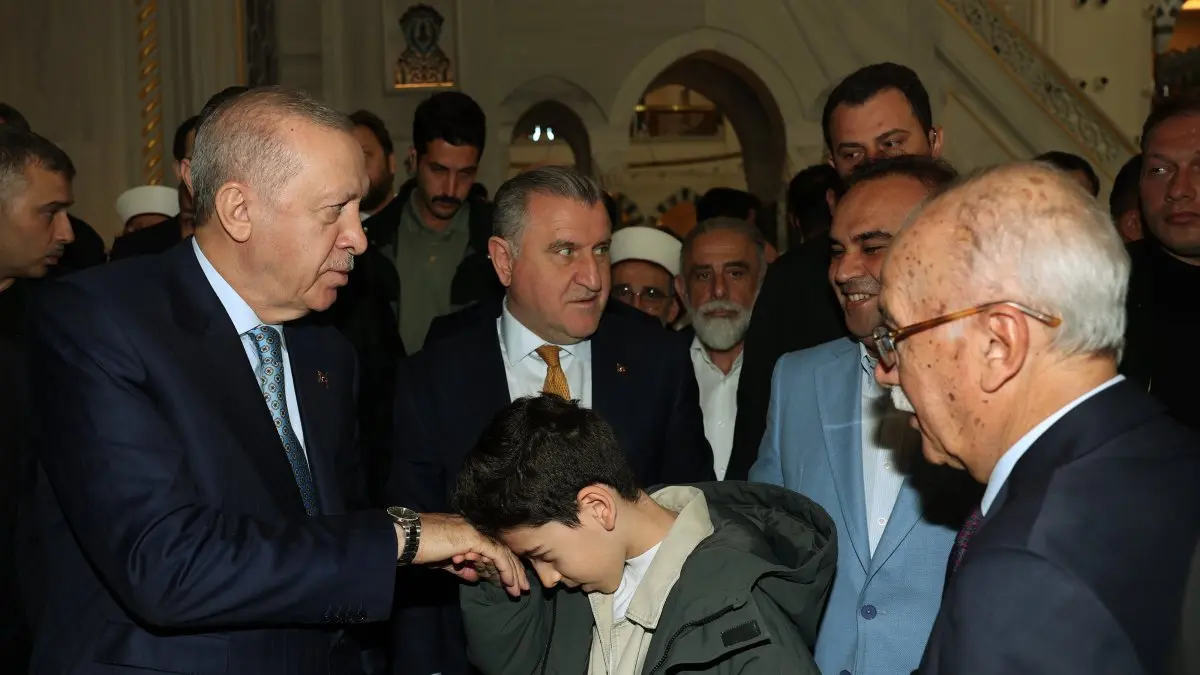
President Recep Tayyip Erdoğan attended Eid al-Adha prayers on Wednesday at Istanbul’s Grand Çamlıca Mosque, using the annual religious occasion to underline themes of unity, devotion, and the ongoing conflict in Gaza. The event marked another instance of the Turkish leader blending religious observance with political messaging, a practice he has maintained throughout his tenure.
The Prayer and Its Setting
Erdoğan departed early morning from his home in Kısıklı, Üsküdar, and arrived at Grand Çamlıca Mosque, where he was greeted by citizens gathered outside. He paused briefly to speak with attendees before entering the mosque for the Eid prayer. The mosque, one of Istanbul’s largest and most modern, opened in 2019 and can hold tens of thousands of worshippers. Its architecture blends Ottoman and Seljuk styles, and it has become a symbol of Erdoğan’s ambitious urban and cultural projects.
Inside, he joined worshippers in the main prayer hall, standing in line with the congregation as imam-hatip Hafız Kerim Öztürk led the service. The scene reflected the egalitarian nature of Islamic prayer, where leaders stand shoulder to shoulder with ordinary citizens. The president remained for the sermon that followed, observing the traditional khutbah delivered to mark the start of Eid al-Adha, known in Türkiye as Kurban Bayramı.
Erdoğan’s Address Inside the Mosque
After prayers concluded, Erdoğan addressed worshippers inside the mosque, framing Eid al-Adha as a religious moment centered on submission, sacrifice, and closeness to God. He referenced the story of Prophet Ibrahim and Ismail as the foundation of the holiday’s meaning, saying the spirit of surrender to God should remain a guiding principle for Muslims. This narrative resonates deeply during Eid al-Adha, which commemorates Ibrahim’s willingness to sacrifice his son in obedience to God.
He called for enduring unity and stability among believers, offering prayers for health and peace, and expressing hope that the sense of brotherhood associated with Eid would extend across generations. His remarks repeatedly returned to the idea that collective strength depends on shared faith and solidarity. Such calls are typical of Erdoğan’s public speeches during religious festivals, but they take on added weight given the challenges facing the Muslim world today.
A significant portion of his address focused on the wider Muslim world, particularly conflict zones. Erdoğan cited Gaza and Palestine as central examples, saying the current conditions there reflected a deeper test for the Islamic world. “We are seeking this submission today in Gaza and in Palestine,” he said, linking the religious message of Eid to resilience amid conflict and describing unity as essential to strength and survival for Muslim communities globally.
Press Interaction and Broader Messaging
Following the mosque address, Erdoğan stepped outside to greet journalists and continue his Eid message in a more informal setting. He described Eid as a period defined by compassion, mutual respect, and social solidarity, while emphasizing that Kurban Bayramı carries a distinct spiritual meaning tied to sacrifice and devotion. He drew a parallel between the ritual of sacrifice and the idea of drawing closer to God, while also referencing the annual Hajj pilgrimage. Pointing to the gathering at Arafat, he said the unity seen during Hajj should serve as a model for global Muslim cohesion, especially as pilgrims begin returning home.
Erdoğan again turned to Gaza during the press interaction, describing the situation as a defining moral issue of the holiday period. He referred to Israeli Prime Minister Benjamin Netanyahu as a “tyrant” and expressed hope that global Muslim communities would respond with stronger collective resolve. He said he expected a clearer stance against the suffering in the region and called for an end to violence. The language was consistent with Erdoğan’s long-standing criticism of Israeli policies toward Palestinians, a stance that has often strained Turkey’s relations with Israel.
He closed his remarks with prayers for peace and unity across the Islamic world, expressing hope that Eid would become a catalyst for greater solidarity and cooperation among Muslim nations. Following the exchange with reporters, refreshments including chocolates and simit were distributed to members of the press.
The Delegation and Broader Context
The president was accompanied by a senior delegation that included former parliament speaker İsmail Kahraman, Youth and Sports Minister Osman Aşkın Bak, Industry and Technology Minister Mehmet Fatih Kacır, Communications Director Burhanettin Duran, Istanbul Governor Davut Gül, Istanbul Police Chief Selami Yıldız, and several senior ruling party officials. Businessman Acun Ilıcalı was also present among attendees. The presence of ministers and local officials underscores the political importance of such religious events, which Erdoğan uses to maintain direct contact with the public and to project leadership on both domestic and international fronts.
Erdoğan’s appearance at Çamlıca Mosque continues a longstanding practice of marking major Islamic holidays in prominent Istanbul mosques, often paired with broader political messaging on domestic cohesion and international affairs. This tradition serves multiple purposes: it reinforces his image as a devout leader, connects him to grassroots supporters, and allows him to address global issues from a religious platform. Over the years, Erdoğan’s Eid messages have evolved from mostly spiritual exhortations to include pointed remarks on geopolitical crises, particularly those involving Muslims.
Significance of Eid al-Adha in Turkey
Eid al-Adha is being observed across Türkiye from May 27 to May 30, with public sector holidays extended for the period. The holiday, known as Kurban Bayramı, involves the ritual slaughter of livestock, with meat distributed to the needy and shared with family and friends. It is a time of charity, prayer, and community gatherings. In Turkey, the week-long public holiday sees millions traveling to visit relatives, and many city dwellers return to their home towns. The government often uses the occasion to announce social aid programs or economic measures aimed at alleviating poverty.
The religious significance of Eid al-Adha stems from the Quranic account of Prophet Ibrahim’s test of faith. Muslims believe that God commanded Ibrahim to sacrifice his son, and when Ibrahim demonstrated his willingness to obey, God provided a ram to sacrifice instead. The holiday thus symbolizes submission to divine will, gratitude, and the importance of charity. For Turkish President Erdoğan, these themes align seamlessly with his political rhetoric, which frequently emphasizes sacrifice for the nation and the ummah.
Historical Context of Erdoğan’s Eid Observances
Since becoming Prime Minister in 2003 and later President in 2014, Erdoğan has made a point of attending large communal prayers at iconic mosques such as the Blue Mosque, Süleymaniye Mosque, and now the Grand Çamlıca. These visits are widely covered in Turkish media and often generate significant social media discussion. In previous years, Erdoğan has used the occasion to announce policy initiatives or to respond to current events. For example, during the 2017 Eid al-Adha, he emphasized the need for national unity following a failed coup attempt, and in 2021, he spoke about Turkey’s economic challenges.
This year’s focus on Gaza is especially poignant given the escalation of violence in the region. Turkey has been a vocal critic of Israel’s military operations in Gaza, calling for an immediate ceasefire and humanitarian access. Erdoğan has repeatedly described Israel’s actions as genocide, a term many Western nations have been hesitant to use. By raising the issue during a religious holiday, Erdoğan frames the conflict in moral and spiritual terms, appealing to the conscience of the Islamic world.
Analysis: The Political Use of Religious Platforms
Erdoğan’s blending of religion and politics is emblematic of his leadership style and of the AK Party’s broader strategy. Since coming to power, the AK Party has sought to make Islam more visible in public life, from loosening restrictions on headscarves to increasing the number of imam-hatip schools. Critics argue that this undermines Turkey’s secular constitution, while supporters claim it merely reflects the religious values of the majority population.
The Eid address offers a unique opportunity to reach a large audience in a setting that many find spiritually resonant. By linking everyday faith to urgent geopolitical issues, Erdoğan encourages his followers to view the conflict in Gaza as a personal moral responsibility. This approach can mobilize public opinion and generate pressure on other Muslim governments to take action. However, it also risks polarizing Turkish society and international relations, especially with Israel and its Western allies.
The choice of the Grand Çamlıca Mosque is also symbolic. Opened in 2019 on a hill overlooking the Bosphorus, the mosque’s construction was promoted by Erdoğan as part of his vision for a “New Turkey.” It represents a blend of tradition and modernity, much like Erdoğan’s political project. Holding the Eid prayer there reinforces his association with national pride and Islamic heritage.
International Reactions and Implications
Erdoğan’s remarks about Netanyahu and Gaza are likely to generate strong reactions abroad. Turkey has already recalled its ambassador to Israel and downgraded diplomatic relations in response to the Gaza conflict. European Union and United States officials have urged restraint on both sides, but Turkey’s stance aligns more closely with that of other Muslim-majority nations, including Qatar and Iran. The use of the term “tyrant” for Netanyahu is a significant escalation in rhetoric, and it may further strain already tense Turkey-Israel relations.
Within Turkey, Erdoğan’s harsh criticism of Israel is popular among his conservative base, but it also draws criticism from opposition parties who argue that the president should focus on domestic problems such as inflation and unemployment. Nonetheless, by focusing on Gaza during Eid, Erdoğan positions himself as a defender of Muslim causes, a role that has historically bolstered his popularity.
Conclusion of the Event
As the Eid al-Adha holiday continues, Erdoğan’s message of unity and solidarity will likely be echoed in sermons across Turkey’s mosques. The annual sacrifice rituals will proceed, with many families offering meat to the poor. Meanwhile, the political implications of the president’s words will reverberate in Ankara and beyond. Whether they translate into concrete policy changes or remain a rhetorical stance remains to be seen. For now, the image of Erdoğan standing shoulder to shoulder with worshippers at the Grand Çamlıca Mosque serves as a powerful symbol of his connection to the people and to the larger Islamic world.
Source:Daily Sabah News