

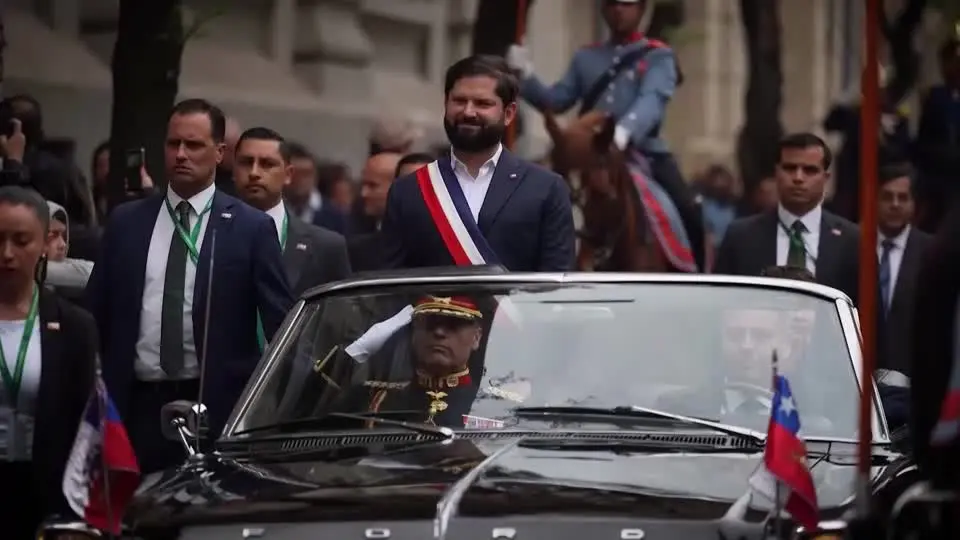
Chilean prosecutors have officially opened an investigation into a sexual harassment claim against President Gabriel Boric, adding to the mounting political challenges faced by his administration. The case, confirmed on Tuesday by the Public Prosecutor's Office, concerns events that allegedly occurred in 2013 when Boric was a law student in Punta Arenas, a southern city near the Strait of Magellan.
The accuser, whose identity has not been publicly disclosed, alleges that Boric harassed her during their time as fellow students at the University of Chile's law school campus in Punta Arenas. According to court documents reviewed by local media, the complaint describes unwanted advances and inappropriate behavior over a period of several weeks. Boric has vehemently denied the allegations, labeling them as 'baseless' and expressing confidence that the judicial process will clear his name.
Boric's legal team issued a statement emphasizing that the complaint was filed by a woman who had previously sent the president unsolicited emails, including one containing explicit images. His lawyer argued that the accuser had repeatedly contacted Boric in a manner that could be interpreted as obsessive, and that the harassment claim appears to be a retaliatory measure after the president did not respond to her advances. The lawyer also noted that no formal charges have been filed and that the investigation remains in its preliminary stages.
The head of the Punta Arenas prosecutor's office, Ana María Morales, confirmed that the case is being processed under standard protocol. She stated that the plaintiff has been offered psychological support and legal counsel, as is customary in such sensitive cases. Morales added that investigators are gathering witness statements and electronic communications to establish the veracity of the allegations.
This is not the first time Boric has faced controversy related to gender violence. Since taking office in March 2022 at the age of 36, he positioned himself as a champion of women's rights and gender equality. His government implemented several progressive policies, including a comprehensive reproductive health law and a national action plan to combat gender-based violence. However, critics argue that the president's personal conduct must align with the public standards he promotes.
The investigation comes at a particularly delicate time for Boric's administration. His approval ratings have plummeted to around 30%, the lowest since he assumed office, due to a combination of economic stagnation, rising crime rates, and a series of political missteps. In recent regional elections, Boric's coalition suffered significant losses, losing control of several key municipalities to opposition parties. Analysts attribute this decline to a broad disenchantment with the government's inability to deliver on its ambitious campaign promises, including constitutional reform and social welfare expansion.
The sexual harassment claim is the second major scandal involving gender-based misconduct to hit Boric's government in just over a month. In late April, the president faced backlash after one of his cabinet members, then-Minister of Mining Juan Carlos Jobet, was accused of rape by a former female colleague. Jobet resigned within 48 hours, vehemently denying the charges, but the incident severely damaged Boric's credibility as a feminist ally. Opposition lawmakers called for Boric to take more decisive action against misconduct within his inner circle, but the president responded by reaffirming his zero-tolerance policy and ordering an independent review of workplace culture in all ministries.
The accumulated scandals have weakened Boric's political standing ahead of next year's presidential election. Although he is not constitutionally allowed to run for a second consecutive term, his party, the Broad Front, is expected to field a candidate from its ranks. The current crisis could fracture the ruling coalition and open the door for conservative or far-right candidates to gain ground in the 2026 election cycle. Polls already show that voters consider integrity and personal conduct as increasingly important factors in their choice of leaders.
Beyond the immediate political fallout, the case raises broader questions about Chile's evolving social norms and legal standards regarding sexual harassment. Chile has made significant strides in recent years, particularly after the 2018 feminist movement 'Ni Una Menos' (Not One Less) mobilized millions demanding justice for victims of gender violence. The country passed a landmark law in 2020 that broadened the definition of sexual harassment and strengthened sanctions. However, enforcement remains uneven, and high-profile cases involving powerful figures often become lightning rods for public debate.
Legal experts note that the investigation into Boric will test the independence of the judiciary, as it is rare for sitting presidents to be subjected to criminal probes. Under Chilean law, a president can be investigated for crimes committed before or during their term, but any charges would require the approval of the Supreme Court. If the case progresses, it could set a precedent for accountability of public servants at the highest level. The accuser's legal team has expressed cautious optimism that the system will handle the case fairly, but they have also appealed to the public to avoid politicizing the matter.
Boric's background as a former student activist and his youthful image once made him a beacon of hope for many Chileans who sought a break from the political establishment. He rose to prominence during the 2011 student protests that demanded free education and social justice. His presidency, the first to be led by a member of the millennial generation, was seen as a transformative moment for the country. However, the combination of unrealistic expectations, a fragmented Congress, and persistent structural problems has tempered that enthusiasm. The current scandal could further erode public trust in government institutions and the broader political class.
As the investigation unfolds, both domestic and international observers will be watching closely. The United Nations Human Rights Committee has previously praised Chile's progress on gender equality, but this case will test whether those commitments extend to the highest office in the land. Boric has promised full cooperation with the authorities and has urged the media to avoid trial by publicity. His supporters argue that the allegations are a smear campaign orchestrated by his political enemies, while detractors see them as a symptom of a culture that still protects men in power.
In Punta Arenas, where the alleged incident took place, residents have expressed mixed reactions. Some believe the accuser's story and have organized peaceful protests demanding a thorough investigation. Others dismiss the claims as politically motivated and have rallied in support of the president. The polarisation reflects the deep divisions that characterise contemporary Chilean society, where issues of gender, class, and politics intersect in complex ways.
The coming weeks will be critical for Boric's government as it tries to manage this crisis while continuing to address other pressing matters such as inflation, public safety, and the ongoing constitutional reform process. The president's ability to navigate this storm will likely determine the remainder of his term and the legacy he leaves behind. For now, the focus remains on the judicial process and whether it will deliver truth and justice for all parties involved.
Source:Yahoo News News