

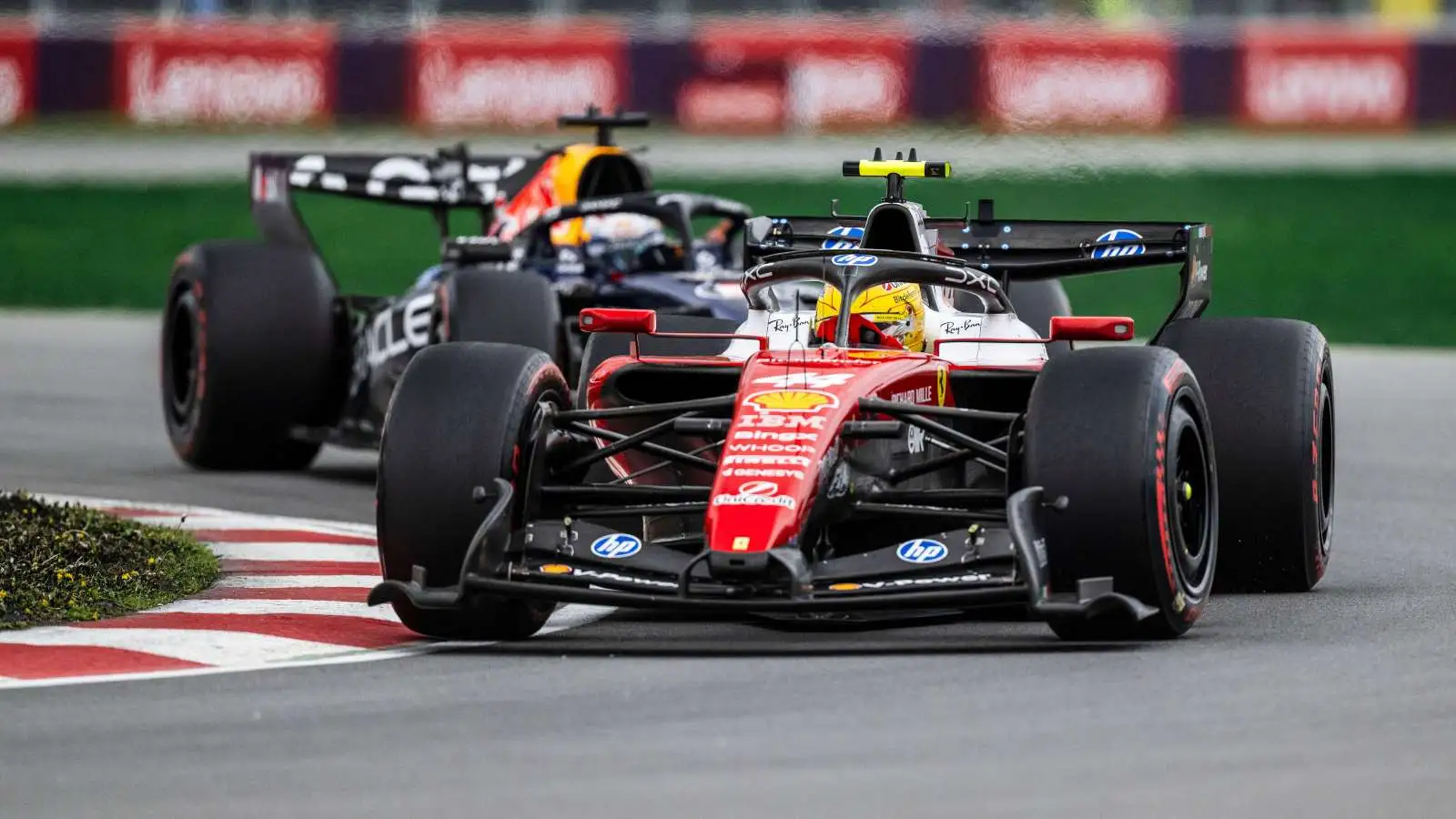
Arguably his best race weekend since arriving at Ferrari, Lewis Hamilton delivered a stellar performance in Canada – a track where he has already taken victory seven times in his career. To make things even sweeter, he clinched the battle for second place against none other than Max Verstappen. With the help of telemetry data, we uncover new details that provide a different perspective on this thrilling battle.
The Battle Unfolds
The seven-time world champion was in peak form throughout the entire weekend in Montreal. Although he fell just short of the perfect qualifying lap to secure a starting position ahead of the McLaren drivers, a positive mood and clear race pace were visible from the British driver. In the end, McLaren’s decision to start on intermediate tires gifted Hamilton a position ahead, as he overtook Piastri at Turn 1 and Norris pitted shortly after. Hamilton found himself third, holding a very strong position for a podium finish, with his old rival Max Verstappen standing in his way.
Verstappen and Red Bull proved faster than expected at the start on soft tires, but their pace later faded on mediums. He quickly got within one second of Hamilton and, on Lap 9, made his move down the inside at Turn 1. Hamilton’s radio call for more power hinted at a critical energy management issue. Telemetry shows that as soon as Verstappen entered the danger zone, Hamilton began increasing his electrical energy deployment on the long straight from the hairpin to Turn 13, knowing that was his most vulnerable sector. The price was a lower top speed on the start-finish straight due to a depleted hybrid battery. Verstappen capitalized on Lap 8, preparing his attack and securing enough speed delta to move into third place.
Over the next laps, Hamilton stayed within a second of Verstappen but found no overtaking opportunity until Lap 22, when a front-right wheel lock-up at Turn 8 forced him off track, losing almost four seconds. This mistake dropped him out of immediate podium contention. The subsequent Virtual Safety Car from Russell’s retirement allowed all front-runners to change tires, setting up a new battle.
Telemetry Insights
At the start of the medium-tire stint, Verstappen struggled to warm up his tires on the cold track surface, opening a window for Hamilton. Over the next few laps, Lewis was consistently faster, and by Lap 45, he had the overtake mode ready. The graph clearly illustrates how the British driver did a better job of warming his tires and finding the optimal rhythm, particularly in traction zones like the Turn 8-9 chicane and the hairpin. Throughout the weekend, Hamilton excelled in these low-grip sections where even his teammate struggled to find a solution.
Taught by his earlier experience, Hamilton knew exactly how to execute his attack. One lap before the move, he increased energy harvesting on the start-finish straight to recharge the battery. He also altered his approach through the final chicane, braking earlier and slower, then delivering all available electrical power to overtake Verstappen down the outside of the start-finish straight. Despite carrying much higher speed, he maintained control under braking and secured second place. Note the speed on the straight during the attack – a truly massive difference compared to earlier laps. Verstappen stayed within a second but had no real counter-attack opportunity. Excellent driving from Hamilton and a well-deserved podium finish.
Ferrari’s Progress and Context
Hamilton’s performance is a significant boost for Ferrari, coming at a track where engine power is particularly critical. This suggests the team’s aerodynamic and chassis development is on the right track. However, it must be noted that his position was aided by Russell’s retirement and McLaren’s tire strategy error. Still, the fact that Ferrari could challenge Red Bull at a power-sensitive circuit bodes well for the remainder of the season.
Hamilton’s history at the Circuit Gilles Villeneuve is storied. With seven wins, he is the most successful driver in Canadian Grand Prix history, and his ability to adapt to Ferrari’s car philosophy has been a key storyline in 2026. The team is working to close the gap in power unit development, while Hamilton’s experience in managing energy and tires remains unmatched. This race demonstrated that Ferrari can be competitive even without a perfect weekend.
Verstappen, despite losing second place, still extended his championship lead thanks to a strong early stint and Red Bull’s consistent pace. The Dutchman remains the favorite for the title, but Hamilton’s resurgence adds intrigue to the championship battle. McLaren’s implosion with a tire gamble and Russell’s heartbreaking retirement further shook up the order, making the Canadian Grand Prix one of the most eventful races of the season.
The telemetry data also reveals subtle differences in driving styles between Hamilton and Verstappen. Hamilton’s ability to preserve brake temperature and manage energy deployment was crucial in the final stint. Verstappen, known for his aggressive corner entry, was forced to compromise his usual approach due to cold tires, allowing Hamilton to close. This strategic duel highlighted the importance of adaptability in ever-changing track conditions.
Ferrari’s car this year has shown strong straight-line speed, but it has sometimes lacked rear grip in slow corners. In Canada, however, the SF-26 seemed well-balanced, and Hamilton’s feedback allowed the engineers to dial in a setup that minimized the tire warm-up issue. This bodes well for upcoming races like Silverstone and Monza, where high-speed corners and straights will favor Ferrari’s strengths.
Looking ahead, the next race in Austria will test Ferrari’s progress on a shorter, more technical track. If Hamilton can replicate this performance, a first win as a Ferrari driver may be imminent. The team is optimistic that continued development in the power unit department will allow them to challenge Red Bull consistently. For now, Hamilton’s masterclass in Canada has flipped the narrative: Ferrari is back in the fight.
Source:PlanetF1 News