

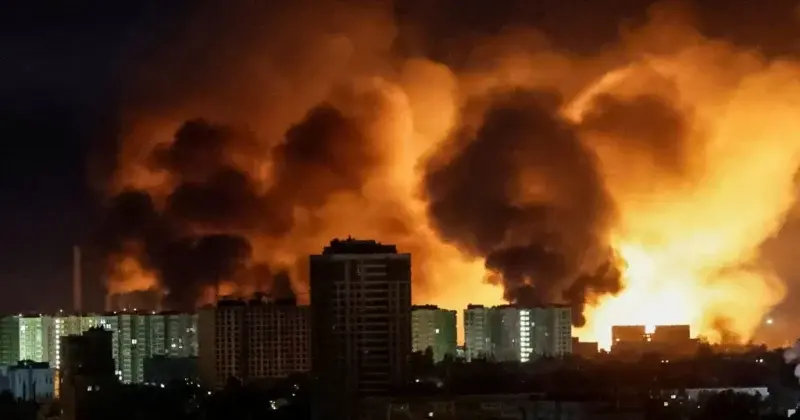
Russia launches massive aerial assault on Kyiv with Oreshnik hypersonic missile
Russia unleashed one of the most punishing aerial barrages of the entire war overnight, sending approximately 600 drones and around 90 missiles at Kyiv and the surrounding Bila Tserkva district. At least two people were killed in the capital, Ukrainian officials confirmed. Among the weapons deployed was the Oreshnik, a hypersonic intermediate-range ballistic missile capable of exceeding Mach 10. This marks only the third confirmed combat use of the system since it was first fired in November 2024, and its reappearance signals that Moscow is willing to keep reaching into its most advanced arsenal.
The attack represents a significant escalation in the conflict, which began in February 2022. The scale of the assault—with hundreds of drones and nearly a hundred missiles—is among the largest seen since the early days of the invasion. Ukrainian air defense systems, bolstered by Western-supplied Patriot and IRIS-T batteries, intercepted a substantial portion of the incoming threats, but debris and falling munitions caused civilian casualties and damage to infrastructure. The Oreshnik, a weapon system designed to evade traditional missile defenses, underscores the ongoing technological arms race between Russia and NATO-aligned forces.
What happened and why the Oreshnik matters
The Oreshnik is a variant of the RS-26 Rubezh, an IRBM originally designed to overwhelm Western missile defense architectures. Its hypersonic speed—over Mach 10—makes it extremely difficult to track and intercept. The missile's combat debut in November 2024 was a major headline, and its subsequent limited use has been closely monitored by defense analysts. The Oreshnik's reappearance in this massive strike suggests that Russia is not only preserving its most sophisticated weapons but is also willing to deploy them in large-scale operations to achieve strategic effects. Ukrainian President Volodymyr Zelenskyy had warned in the days leading up to the strike that a large-scale attack was likely, based on intelligence assessments of Russian troop movements and missile stockpiling. This pre-warning may have allowed some preparation, but the sheer volume of projectiles still overwhelmed certain sectors of the air defense network.
Beyond the immediate destruction, the Oreshnik's use carries psychological and propaganda value. It demonstrates to both domestic and international audiences that Russia retains advanced military capabilities despite prolonged sanctions and battlefield setbacks. For Ukraine, each successful intercept of such weapons boosts morale, but the low number of interceptions against hypersonic threats highlights the need for even more advanced defense systems. The attack also puts pressure on Western allies to accelerate deliveries of systems like the THAAD or more advanced Patriot variants.
How geopolitical shocks ripple through crypto
No immediate crypto market disruptions or notable token movements were reported in the hours following the strike. Major cryptocurrencies like Bitcoin and Ethereum traded within narrow ranges, and trading volumes remained stable across most exchanges. However, prior escalations in the Russia-Ukraine conflict have historically resulted in decreased Bitcoin trading volume and downward price pressure. The pattern is consistent with broader risk-off behavior: when missiles fly, investors pull liquidity from volatile assets first and ask questions later. For example, the initial invasion in February 2022 saw Bitcoin drop from around $44,000 to below $35,000 within days, with trading volumes on major exchanges slumping as retail and institutional investors moved to safe-haven assets like gold and U.S. Treasuries.
The lack of an immediate sell-off this time could reflect that markets may have already priced in continued escalation after Zelenskyy’s pre-attack warnings. Over the past two years, crypto markets have become somewhat desensitized to geopolitical flashpoints, partly because the asset class has matured and gained more mainstream adoption. However, the sensitivity to tail-risk events remains high, especially for leveraged positions. Analysts note that the initial non-reaction often gives way to a slow grind lower in trading volumes as institutional desks reduce exposure to assets that could suffer from sudden liquidity crunches. This phenomenon was observed after the missile strike on a Polish border village in November 2022, where Bitcoin traded flat for 24 hours before declining 8% over the following week.
What investors should actually watch
If NATO allies respond with new weapons packages or expanded sanctions, the crypto market could face multiple indirect pressures. Previous rounds of sanctions have targeted Russian exchanges, complicated stablecoin flows through certain corridors, and pushed mining operations to relocate. After the invasion of Ukraine, several Russian crypto exchanges were forced to suspend services or move to jurisdictions with friendlier regulations, reducing liquidity in the ruble-crypto pairs. Additionally, the U.S. Treasury's Office of Foreign Assets Control (OFAC) has sanctioned entities involved in circumventing sanctions through cryptocurrency, leading to increased compliance costs for exchanges worldwide. Such measures could tighten stablecoin issuance on platforms like Tron and Ethereum, as providers fear secondary sanctions.
Large-scale missile strikes on Ukrainian infrastructure have previously disrupted European energy supplies, spiking natural gas prices. For instance, in the winter of 2022-2023, repeated strikes on the Ukrainian power grid reduced gas flows through pipelines to Europe, causing gas prices to rise by over 20% in a month. Higher energy costs feed into Bitcoin mining economics, potentially squeezing margins for operators already running on thin profitability after the most recent halving cycle. The April 2024 halving cut block rewards from 6.25 to 3.125 BTC per block, reducing miner revenues by half. With energy costs rising, miners with inefficient hardware may be forced to shut down or sell their Bitcoin holdings, adding selling pressure to the market. This dynamic was evident in mid-2024 when a spike in European gas prices coincided with a 10% drop in Bitcoin's hashrate and a 5% price decline.
Historical precedent from earlier phases of the conflict shows that the initial non-reaction often gives way to a slow grind lower in trading volumes as institutional desks reduce exposure to tail-risk assets. Hedge funds and family offices, which had increased their crypto allocations during the bull market of 2023-2024, are particularly sensitive to geopolitical uncertainty. They tend to reduce positions in assets with low volume and high volatility, Bitcoin included. Retail investors, on the other hand, may see such events as buying opportunities, but the overall market direction often depends on the liquidity provided by institutional players. If this strike leads to a broader escalation—such as Russian attacks on critical infrastructure in NATO border states—the risk-off mood could intensify, driving Bitcoin into a prolonged consolidation or correction.
Another factor to consider is the potential for regulatory shifts. Geopolitical crises often accelerate legislative moves to increase oversight of cryptocurrency transactions, especially if they are used to evade sanctions. The European Union's Markets in Crypto-Assets (MiCA) regulation, which came into full effect in 2025, already imposes strict know-your-customer (KYC) and anti-money laundering (AML) requirements. In response to the renewed conflict, EU officials may push for even tighter controls on cross-border stablecoin transfers, particularly those involving countries with ties to Russia. Such measures could slow down the speed of capital movement and increase transaction costs, discouraging traders who rely on fast, cheap transfers.
From a broader perspective, the Oreshnik strike reaffirms that geopolitical risk remains a top-tier concern for crypto investors. Unlike traditional markets, where gold and bonds act as safe havens, crypto assets have not yet proven to be a reliable hedge during violent conflicts. Bitcoin's correlation with risk assets like tech stocks has been inconsistent, but during acute geopolitical shocks, it often behaves like a high-beta asset. This means that while the immediate market response may be muted, the delayed effects—lower volumes, tighter spreads, and eventual price declines—are more likely. Investors should monitor energy prices, sanctions announcements, and mining hashrate data closely in the coming weeks.
Source:Crypto Briefing News