How Can I Learn More About Cryptocurrency and Blockchain Technology?

Complete cryptocurrency and blockchain learning guide: foundational concepts, platform-specific courses, smart contract development, professional certifications, and career paths.
Learning cryptocurrency and blockchain technology in 2026 has become accessible through diverse, structured pathways ranging from free foundational resources to advanced professional certifications. Over 30 major educational platforms now offer cryptocurrency and blockchain courses, with 821,000+ learners enrolled in Princeton University's "Bitcoin and Cryptocurrency Technologies" course alone. This comprehensive guide provides systematic learning approaches for all levels: beginners (foundations through interactive tutorials), intermediate learners (platform-specific development), advanced developers (smart contract programming), and professionals seeking credentials. Success in cryptocurrency education requires understanding foundational concepts (cryptography, consensus mechanisms, decentralization), progressing through specific platform mastery (Bitcoin, Ethereum, Solana), and specializing through hands-on development projects or professional certifications.
Understanding Why Cryptocurrency and Blockchain Learning Matters
Cryptocurrency and blockchain represent fundamental technological innovation reshaping finance, supply chain management, healthcare, legal systems, and organizational governance. Bitcoin, introduced in 2009, demonstrated proof-of-concept for decentralized digital currency. Ethereum (2015) introduced smart contracts—programmable transactions enabling thousands of decentralized applications. By 2025, blockchain applications span DeFi (decentralized finance), NFTs (digital ownership), supply chain transparency, digital identity, and Web3 infrastructure.
Career opportunities in blockchain have expanded dramatically. Blockchain developers command average salaries of $150,000-$200,000+ annually. Blockchain consultants advising enterprises on implementation earn $200,000-$500,000+. Even non-technical roles (product management, legal compliance, community management) pay substantially. Learning cryptocurrency and blockchain technology represents strategic career investment yielding long-term professional and financial returns.
Educational demand has driven platform proliferation. Universities like Princeton, UC Berkeley, MIT, and Harvard offer free or affordable courses. Platforms like Coursera, edX, Udacity, and Udemy provide professional-grade education. Specialized bootcamps (Alchemy University, ConsenSys Academy, Metana) train developers intensively. This abundance creates both opportunity and decision paralysis—knowing which resources suit your goals is essential.
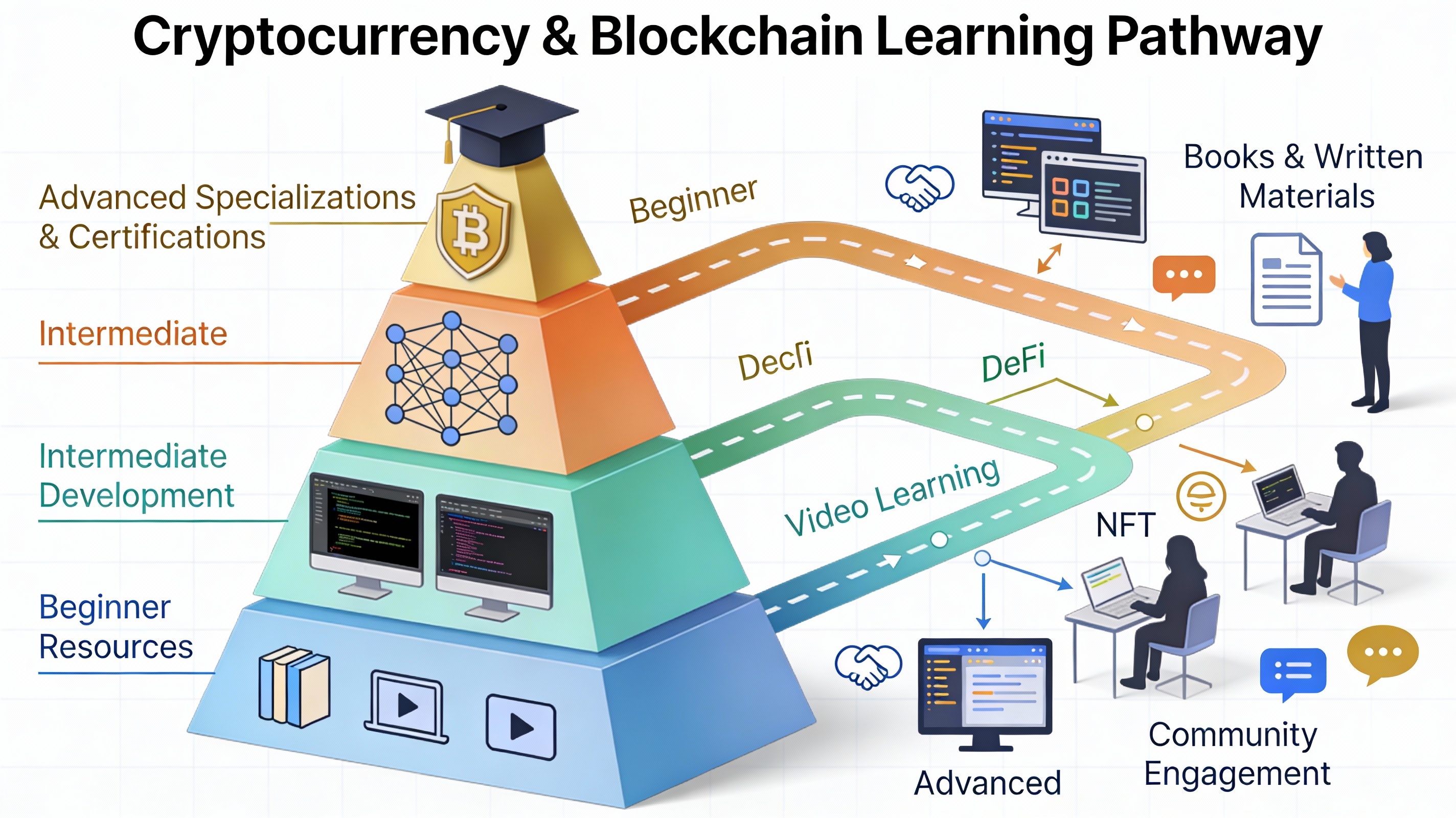
Level 1: Foundational Learning (Weeks 1-4)
Objective: Understand Core Concepts
Begin with foundational concepts applicable across all cryptocurrency and blockchain applications. This level requires no prior technical expertise and builds essential vocabulary and conceptual understanding.
Essential Concepts to Master:
- Cryptography Basics: How does encryption work? What are public and private keys? How do digital signatures prove ownership without revealing secrets? Understand that cryptography secures cryptocurrency transactions, making them tamper-proof.
- Distributed Ledgers: What is a ledger? How do distributed ledgers differ from traditional databases? Why does decentralization matter? Understand that distributed ledgers maintain identical records across thousands of computers, eliminating single points of failure.
- Consensus Mechanisms: How do thousands of independent computers agree on correct transaction records? Proof of Work (Bitcoin, Ethereum historically) requires computational puzzle-solving. Proof of Stake (Ethereum currently) rewards long-term token holders. Delegated Proof of Stake (Polkadot, Cosmos) combines both approaches.
- Blockchain Structure: What is a block? How do blocks chain together? Why can't previous transactions be altered? Understand that each block contains transaction data plus a cryptographic hash referencing the previous block—changing any prior transaction breaks the chain, making fraud immediately apparent.
- Decentralization Philosophy: Why do we need decentralization? Who benefits from removing intermediaries? What trade-offs exist (speed, complexity, regulation)? Understand that decentralization transfers control from institutions to users, enabling peer-to-peer transactions.
- Bitcoin Basics: Why was Bitcoin created? How many bitcoins exist? What is halving? How does proof of work secure Bitcoin? Understand Bitcoin's role as digital currency and store of value.
- Ethereum and Smart Contracts: How do smart contracts differ from Bitcoin's simpler transactions? What is Solidity? What are dApps (decentralized applications)? Understand that Ethereum's programmability enables thousands of applications beyond currency.
- Tokenomics: What determines cryptocurrency value? What is token supply and inflation? What incentivizes network participants? Understand that tokenomics designs economic systems aligning incentives toward network health.
Recommended Free Resources (Weeks 1-4):
Coinbase Learn (2-3 hours): Completely free, non-technical explanations of 50+ cryptocurrency concepts. Ideal for absolute beginners building vocabulary. Clear animations and simple language.
Binance Academy (3-4 hours): Free cryptocurrency education from the world's largest exchange. Covers Bitcoin, Ethereum, DeFi, NFTs, and trading basics. Multilingual support. No registration required.
101 Blockchains Fundamentals Free Course (4 hours): Structured course covering blockchain fundamentals, smart contracts, and business applications. Interactive exercises reinforce learning. Certificate available.
Princeton University's "Bitcoin and Cryptocurrency Technologies" (40 hours, but you can sample freely): The definitive academic course with 821,000+ enrolled students and 4.6/5 rating. Available free on Coursera (audit) or YouTube. Pairs theoretical rigor with practical insights. Perfect for understanding Bitcoin's technical foundations.
Time Requirement: 10-15 hours of self-paced learning across 2-4 weeks
Level 2: Platform-Specific Learning (Weeks 5-12)
Objective: Understand Major Blockchain Platforms
After grasping foundational concepts, specialize in specific platforms based on your interests. Major platforms represent different design philosophies and use cases.
Bitcoin Deep Dive (2-3 weeks):
Bitcoin remains cryptocurrency's foundational technology. Understanding Bitcoin's architecture, limitations, and design decisions provides perspective for evaluating all subsequent cryptocurrencies.
- How Bitcoin transactions work (UTXO model)
- Mining mechanics and difficulty adjustment
- Wallet security and private key management
- Bitcoin's scripting language and limitations
- Halving events and their effects on supply and price
- Layer 2 solutions (Lightning Network) enabling faster transactions
Recommended Resource: "Mastering Bitcoin: Programming the Open Blockchain" by Andreas M. Antonopoulos (4.7/5 rating). Technical but comprehensive. Covers architecture, transactions, and security. Ideal for understanding Bitcoin thoroughly.
Ethereum Deep Dive (3-4 weeks):
Ethereum's programmability opens possibilities beyond currency. Understanding Ethereum enables exploration of DeFi, NFTs, and Web3.
- Ethereum account models (addresses, wallets, contracts)
- Transaction structure and gas mechanics
- Smart contract basics and Solidity programming
- Consensus mechanism evolution (Proof of Work to Proof of Stake)
- Ethereum Virtual Machine (EVM) operations
- Layer 2 scaling solutions (Polygon, Arbitrum, Optimism)
- DeFi protocols (Uniswap, Aave, Curve)
- NFT standards (ERC-721, ERC-1155)
Recommended Resource: edX's "Berkeley Blockchain Fundamentals" (9 hours, free). UC Berkeley's professional certificate with rigorous academic approach. Includes free Solidity course and code-along projects. Highly rated for clarity and depth.
Solana, Polkadot, Cardano Overview (1-2 weeks):
Understand how alternative Layer 1 blockchains differ from Bitcoin and Ethereum. Each represents different design trade-offs balancing speed, security, and decentralization.
- Solana: High-speed (65,000+ TPS), Proof of History consensus
- Polkadot: Interoperability focus, multichain architecture
- Cardano: Academic-driven development, Ouroboros consensus
- Cosmos: Interconnected blockchains, modular architecture
Recommended Resource: Official platform documentation and Moralis Academy (combines dev + trading curriculum, blended learning approach).
Time Requirement: 60-80 hours across 8 weeks, or compress to 4-5 weeks with intensive study
Level 3: Developer and Technical Learning (Weeks 13-24)
Objective: Build Functional Blockchain Applications
Technical learning enables hands-on development. Choose based on specialization interest: smart contract development, full-stack dApp building, or blockchain infrastructure.
Smart Contract Development (Solidity Focus, 6-8 weeks):
Smart contracts are programmable transactions executing deterministic logic on blockchains. Solidity remains the primary language (Ethereum, Polygon, Binance Smart Chain, Arbitrum, Avalanche).
Solidity Learning Path:
- Week 1-2: Language fundamentals (variables, functions, control flow)
- Week 3: Object-oriented concepts (inheritance, interfaces, contracts)
- Week 4-5: Ethereum-specific topics (address types, gas, external calls)
- Week 6-7: Security and best practices (reentrancy, overflow/underflow, access control)
- Week 8+: Advanced patterns (proxies, upgradeable contracts, oracle integration)
CryptoZombies (Free, game-based learning): The most popular interactive Solidity tutorial with 400,000+ users. Step-by-step lessons progress from basics to creating NFT-enabled games. Completely free. Engaging game-based format maintains motivation.
Alchemy University (Free, comprehensive bootcamp): Consensys-backed platform providing professional-grade smart contract education. Code-along projects with Ethereum mainnet. Hackathons and community support. Certificate upon completion.
Moralis Academy (Paid, blended): Combines structured dev courses with trading strategy content and community. Appeals to both developers and traders. Hands-on projects.
ConsenSys Academy (Paid, mentor-led): Intensive bootcamp with instructor mentorship, cohort-based learning, and career support. Higher barrier to entry but stronger outcomes for serious learners.
Full-Stack dApp Development (8-12 weeks):
Building complete decentralized applications requires frontend development, smart contracts, and blockchain interaction.
Essential Technologies:
- Frontend frameworks (React, Vue, Angular)
- Web3 libraries (Web3.js, Ethers.js, wagmi)
- Smart contract frameworks (Hardhat, Truffle, Foundry)
- IPFS for decentralized storage
- Wallet integration (MetaMask, WalletConnect)
- Testing and deployment strategies
Blockchain Infrastructure and Node Operation (4-8 weeks):
Advanced developers interested in network-level infrastructure learn node operation, validator setup, and protocol-level programming.
Time Requirement: 200-300 hours over 12-24 weeks depending on depth and prior programming experience
Level 4: Professional Certification and Advanced Specialization
Objective: Earn Credentials and Specialize
Professional certifications demonstrate expertise to employers and clients, opening career doors and commanding premium compensation.
Certified Blockchain Professional Credentials:
Certified Blockchain Developer (CBD) - 6-8 weeks
- Covers blockchain architecture, smart contracts, security
- Hands-on projects with Ethereum and Hyperledger
- Recognized by enterprises hiring blockchain developers
Certified Cryptocurrency Expert (CCE) - 8-10 weeks
- Covers cryptocurrency fundamentals, economics, regulations, trading
- 11-hour structured curriculum
- Exam-based certification
Certified Bitcoin Professional (CBP) - 4-6 weeks
- Bitcoin-specific expertise
- Target: Bitcoin developers, traders, compliance professionals
- Demonstrates Bitcoin knowledge depth
Certified Blockchain Product Manager (CBPM) - 6-8 weeks
- Non-technical credential for product management roles
- Covers business implications, product strategy, regulatory
- Growing demand as enterprises build blockchain products
University-Backed Credentials:
University of Nicosia Master's in Digital Currency (Full degree, 2 years online): The world's first university master's degree in cryptocurrency. Rigorous academic program. Graduates work at leading blockchain organizations.
Princeton University Certificate (Partial completion of full course): Demonstrates mastery of foundational concepts with academic backing.
UC Berkeley Blockchain Fundamentals Certificate (8-9 weeks, paid): Professional certificate from top-ranked university. Recognized by enterprises.
Time Requirement: 4-12 weeks for individual certifications; 2 years for master's degree
Alternative Learning Paths
YouTube and Video-Based Learning
MIT OpenCourseWare - "Blockchain and Money" (MIT course, free): Gary Gensler's comprehensive blockchain course. Available on YouTube. Covers Bitcoin, Ethereum, DeFi, and regulatory implications. 500+ hours of content.
Andreas M. Antonopoulos YouTube Channel: Former Bitcoin Chief Scientist. Hundreds of free videos explaining cryptocurrency concepts, Bitcoin fundamentals, and technical deep-dives. Extremely clear explanations.
Crypto Educational YouTube Channels: Coin Bureau, Whiteboard Crypto, 3Blue1Brown (mathematics-focused cryptography), Finematics (DeFi protocol explanations).
Books and Written Resources
Tier 1 - For Absolute Beginners:
- "Blockchain Basics" by Daniel Drescher: 25-step, non-technical introduction without programming or math
- "The Basics of Bitcoins and Blockchains" by Antony Lewis: Best introduction covering Bitcoin, Ethereum, ICOs, wallets, exchanges, regulations
Tier 2 - For Growing Knowledge:
- "Mastering Bitcoin" by Andreas M. Antonopoulos: Technical breakdown of Bitcoin architecture, transactions, security. Developer-oriented.
- "Mastering Ethereum" by Andreas M. Antonopoulos & Gavin Wood: Comprehensive guide to Ethereum, smart contracts, dApp development
Tier 3 - For Advanced Understanding:
- "Mastering Blockchain" by Imran Bashir: Comprehensive textbook covering blockchain architecture, consensus, cryptography, smart contracts, DApps, platforms (Ethereum, Hyperledger, Polkadot)
- "The Bitcoin Standard" by Saifedean Ammous: Austrian economics perspective on Bitcoin as sound money alternative to fiat currency
Tier 4 - For Specialized Knowledge:
- "Proof of Stake" by Vitalik Buterin (et al.): Philosophy and technical details of Ethereum's shift to proof of stake
- "Cryptoassets: The Innovative Investor's Guide" by Chris Burniske & Jack Tatar: Investment perspective on cryptocurrency assets
Tier 5 - For Visionary Perspective:
- "The Network State" by Balaji S. Srinivasan: How blockchain and digital technologies reshape governance
- "The Sovereign Individual" by James Dale Davidson & Lord William Rees-Mogg: Blockchain's societal implications (older but prescient)
Community Learning
Reddit Communities:
- r/cryptocurrency: General discussion, news, market analysis
- r/CryptoTechnology: Technology-focused discussion
- r/blockchain: Blockchain technology specific
- r/Ethereum: Ethereum ecosystem
- r/Bitcoin: Bitcoin focused
- r/defi: Decentralized finance protocol discussion
- r/solana: Solana ecosystem
- r/web3: Web3 and decentralized internet
Discord Communities:
- Official cryptocurrency/blockchain project Discord servers
- Alchemy University community
- Moralis Academy
- Crypto Devs communities
- Trading communities
Conferences and Events:
- Consensus (CoinDesk) - largest annual crypto conference
- ETHDenver - Ethereum developer conference
- Ethereum Foundation events
- Local blockchain meetups
- Web3 hackathons
Hands-On Project-Based Learning
The most effective learning combines theory with hands-on projects:
- Deploy a Simple Smart Contract: Write, test, deploy ERC-20 token contract on testnet
- Build a Portfolio Tracker: Create web app integrating CoinGecko API displaying crypto holdings
- Develop a DeFi Flash Loan Arbitrage Bot: Deploy automated trading strategy on testnet
- Create an NFT Collection: Code and deploy ERC-721 smart contract
- Build a DAO (Decentralized Autonomous Organization): Implement governance token and voting mechanism
- Contribute to Open-Source: Contribute to blockchain projects (Bitcoin Core, Ethereum, Solana)
Learning Strategy by Goal
Goal 1: General Cryptocurrency Understanding (for Investors)
Timeline: 4-6 weeks
Resource Path:
- Coinbase Learn basics (2-3 hours)
- Binance Academy (3-4 hours)
- "The Basics of Bitcoins and Blockchains" book (20 hours reading)
- Princeton's "Bitcoin and Cryptocurrency Technologies" course (sample first 10 hours)
- Establish investment thesis and track portfolio
Success Metric: Can explain Bitcoin, Ethereum, blockchain fundamentals to a knowledgeable person. Understand tokenomics and can evaluate crypto projects.
Goal 2: Technical Competency (for Developers)
Timeline: 16-24 weeks
Resource Path:
- Foundational concepts (Level 1) - weeks 1-4
- Ethereum deep dive (Level 2) - weeks 5-8
- Solidity development (CryptoZombies + Alchemy University) - weeks 9-16
- Full-stack dApp project - weeks 17-24
- Deploy to mainnet
Success Metric: Deploy functional smart contract to mainnet. Build and deploy complete dApp. Contribute code to blockchain projects.
Goal 3: Professional Credentials
Timeline: 12-16 weeks
Resource Path:
- Foundational concepts (Level 1) - weeks 1-4
- Platform-specific learning (Level 2) - weeks 5-8
- Certification coursework - weeks 9-16
- Pass certification exam
Success Metrics: Earn recognized credential (CBD, CBP, CBPM, or CCE). Advance to blockchain-related role.
Goal 4: Entrepreneurship and Product Development
Timeline: 20-32 weeks
Resource Path:
- Foundational concepts (Level 1) - weeks 1-4
- Platform-specific deep dive (Ethereum focus) - weeks 5-8
- Full-stack development (weeks 9-20)
- Business and product (CBPM certification) - weeks 21-28
- Launch product/service - weeks 29-32
Success Metric: Launch blockchain-based product with active users. Secure funding or achieve profitability.
India-Specific Learning Considerations
Regulatory Environment: RBI discourages cryptocurrencies but hasn't banned them. Understanding regulatory landscape is essential for responsible participation.
Affordable Education: Many quality resources are free or low-cost. Coursera and edX courses are affordable ($15-50/month for access); books cost $15-30; bootcamps range $5,000-15,000 but payment plans available.
Community: India has vibrant crypto communities through:
- Local blockchain meetups in major cities (Delhi, Mumbai, Bangalore)
- Reddit communities with Indian members
- Discord servers focused on Indian investors/developers
- WhatsApp groups (though verify information carefully)
Language Considerations: Most quality resources are in English. Hindi language resources exist but limited. Learning technical vocabulary in English is beneficial.
Taxation and Compliance: Understand tax implications of crypto trading and income. Consult tax professionals familiar with cryptocurrency. Resources like ClearTax provide India-specific guidance.
Common Mistakes to Avoid
Mistake 1: Skipping Fundamentals: Attempting smart contract development without understanding blockchain basics causes confusion. Always start with foundational concepts.
Mistake 2: Trying Multiple Resources Simultaneously: Jumping between 5 courses overwhelms and prevents depth. Commit to 1-2 resources per level.
Mistake 3: Learning Without Practicing: Watching videos without hands-on projects creates illusion of knowledge. Code along with tutorials.
Mistake 4: Ignoring Security: Learning without understanding private key management and security basics leads to losses. Prioritize security education early.
Mistake 5: Following Social Media "Gurus": Much cryptocurrency education on social media is scams, misleading, or biased. Prioritize academic sources (universities, established platforms).
Mistake 6: Focusing Only on Price/Trading: Understanding technology is more important than predicting price movements. Strong technical knowledge enables better long-term decisions.
Mistake 7: Ignoring Regulations: Cryptocurrency operates in evolving regulatory landscape. Understand compliance and legal implications relevant to your jurisdiction.
Measuring Learning Progress
Knowledge Checkpoints:
- Week 4: Can explain blockchain, Bitcoin, Ethereum basics to non-technical person
- Week 12: Can discuss specific platform architectures, consensus mechanisms, smart contracts
- Week 24: Can develop simple smart contracts, understand security implications, evaluate protocols
Practical Milestones:
- Deploy testnet smart contract successfully
- Build and deploy dApp to production
- Contribute code to blockchain open-source project
- Pass professional certification exam
- Teach concepts to others (explaining cements understanding)
Conclusion: Cryptocurrency and Blockchain Learning as Strategic Career Investment
Learning cryptocurrency and blockchain technology in 2025 represents strategic career investment yielding substantial returns. The learning landscape has matured dramatically—no longer requiring deep mathematics or specialized hardware. Quality education is accessible to anyone willing to invest time and moderate resources.
Success requires patience. Cryptocurrency and blockchain span computer science, cryptography, economics, law, and philosophy. Complete mastery takes years. However, practical competency—sufficient to develop smart contracts, understand protocols, or evaluate investments—is achievable in 4-6 months of dedicated study.
Choose learning resources matching your goals, commit to progression through levels, prioritize hands-on practice, and avoid the common pitfalls that derail many learners. The most successful crypto learners combine multiple resources, engage with communities, and consistently ship projects demonstrating their knowledge.
The future increasingly belongs to professionals understanding blockchain technology. Whether your goal is investment competency, technical expertise, entrepreneurship, or organizational leadership, learning cryptocurrency and blockchain is investing in your future.
Comments 0
Most Read
What Is the Concept of Tokenization in Blockchain?

Bitcoin & Ethereum Market Momentum Update

Recommended Post
What Is the Concept of Tokenization in Blockchain?

How Do I Avoid Common Mistakes When Trading Cryptocurrencies?
How Do I Recover a Lost Cryptocurrency Wallet?
How Can I Learn More About Cryptocurrency and Blockchain Technology?

How Do I Track Cryptocurrency Prices in Real-Time?


Leave a Comment